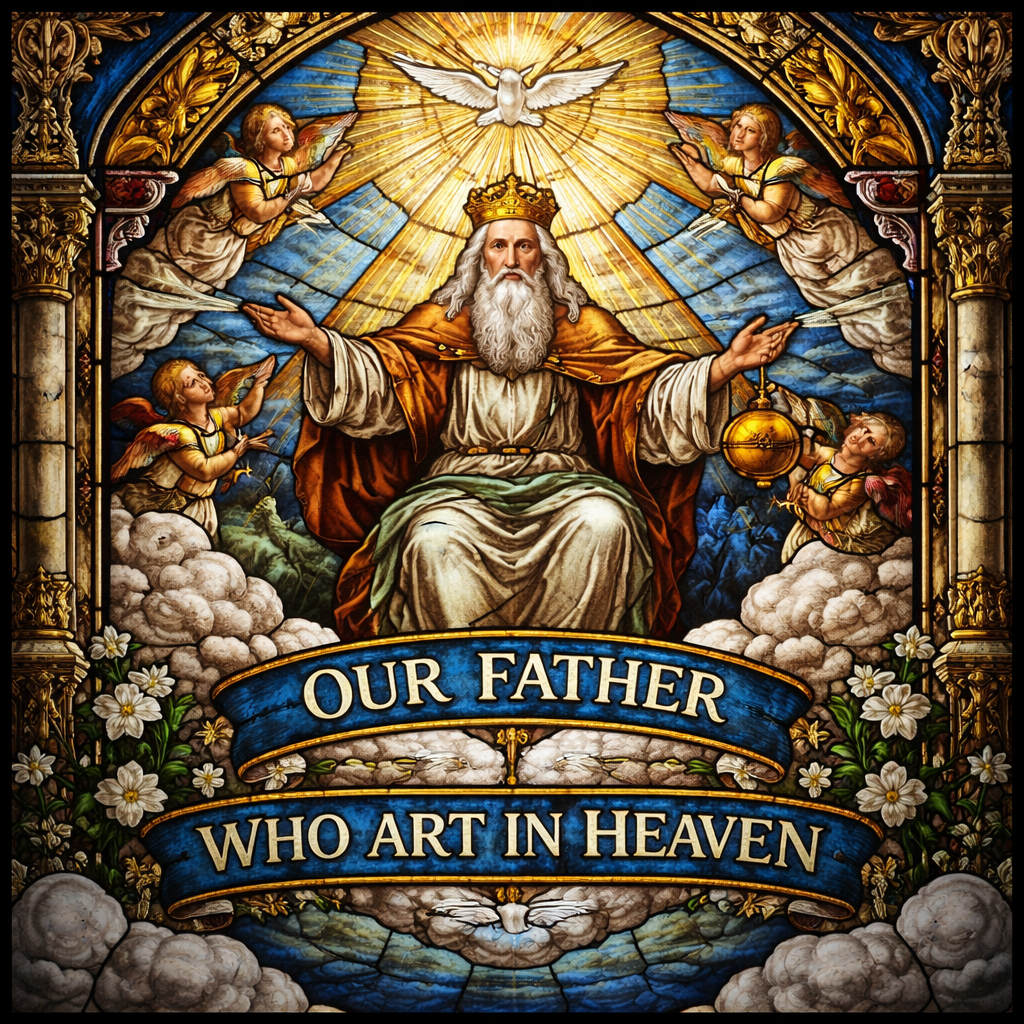
When we pray, “Our Father who art in heaven,” we are not merely reciting words; we are being taught how to approach God rightly. Before we even ask anything of Him, we are instructed in the posture of prayer, the confidence we must have, and the object of our desire. Of all things required in prayer, faith is essential.
“But let him ask in faith without any doubting, for the one who doubts is like the surf of the sea driven and tossed by the wind.” (James 1:6 NAS)
Thus, prayer is not rooted in uncertainty, but in trust. We do not approach a distant or unwilling God, but a Father who is both able and willing to hear. God is said to be “in heaven.” This does not mean He is confined to a finite location.
“But will God indeed dwell on the earth? Behold, heaven and the highest heaven cannot contain Thee, how much less this house which I have built!” (1Ki 8:27 NAS)
We must understand who God is.
Understanding who God is lies at the very heart of the Christian faith and prayer. Scripture does not leave us to speculation or imagination, but reveals God’s nature through His works, His words, and His self-disclosure. The attributes of God are those perfections that describe what God is in Himself, not merely what He does, but who He is eternally.
These attributes are not separate parts of God, as though He were divided. Rather, each attribute describes the fullness of His one, undivided being. There is only one God.
“You are My witnesses,” declares the LORD, “And My servant whom I have chosen, In order that you may know and believe Me, And understand that I am He. Before Me there was no God formed, And there will be none after Me. “I, even I, am the LORD; And there is no savior besides Me.” (Isa 43:10-11 NAS)
We must understand who God is, for in prayer we come before the one true God as He has revealed Himself, not as we imagine Him to be.
God created all things.
Everything God created is less than Him. We pray to God the Father because He created us. He is the only God and there is no other.
“Know therefore today, and take it to your heart, that the LORD, He is God in heaven above and on the earth below; there is no other.” (Deu 4:39 NAS)
There is no other God. He alone created all things.
“I, the LORD, am the maker of all things, Stretching out the heavens by Myself, And spreading out the earth all alone.” (Isa 44:24 NAS)
“All things came into being by Him, and apart from Him nothing came into being that has come into being.” (John 1:3 NAS)
God created all things, and our prayers are directed to Him alone, for there is no other God.
God Is Self-Existent.
God depends on nothing outside of Himself for His existence. He is not sustained by creation, nor is He contingent upon anything beyond His own being. He simply is.
“And God said to Moses, ‘I AM WHO I AM’; and He said, ‘Thus you shall say to the sons of Israel, I AM has sent me to you.'” (Exo 3:14 NAS)
We pray to God because He is the source of all things, while Himself being sourced by none. For the believer, this brings great comfort: the One upon whom we rely is never in need, never diminished, and never unstable.
God Has No Beginning or End.
God exists beyond time. He does not come into being, nor does He pass away.
“I am the Alpha and the Omega,” says the Lord God, “who is and who was and who is to come, the Almighty.” (Revelation 1:8)
There is no time when God did not exist. He is everlasting.
“Before the mountains were brought forth, or ever you had formed the earth and the world, from everlasting to everlasting you are God.” (Psalm 90:2)
God is eternal, so His promises are not bound by time; what He has spoken stands forever, and what He has purposed cannot fade.
“Your throne, O God, stands forever and ever; the scepter of your kingdom is a scepter of justice.” (Psalm 45:6)
The Father is worthy of our prayer because His promises are forever.
God Does Not Change.
God is unchanging in His being, character, and purposes. He does not grow, evolve, or shift as creatures do.
“For I the Lord do not change; therefore you, O sons of Jacob, are not consumed.” (Malachi 3:6)
This same unchanging nature is affirmed in Christ:
“Jesus Christ is the same yesterday and today and forever.” (Hebrews 13:8)
God does not change, so we pray with confidence, knowing that His mercy, truth, and promises remain the same. This certainty is grounded in His faithful character:
“For the faith of those chosen of God and the knowledge of the truth which is according to godliness, in the hope of eternal life, which God, who cannot lie, promised long ages ago.” (Tit 1:1-2 NAS)
God is immutable; His mercy does not diminish, His truth does not shift, and His covenant does not fail.
God Is Without Limit.
God is not bound by space, power, or measure. He is infinite in His being and perfection.
“Great is our Lord, and abundant in strength; His understanding is infinite.” (Psa 147:5 NAS)
There is no boundary to God’s greatness. No comparison can fully capture Him.
“For who in the sky can equal the Lord? Who among the gods is similar to the Lord?” (Psalm 89:6–7)
This reminds us that God is not merely greater than creation, He is categorically beyond creation. God has no limits; therefore, we pray with confidence, knowing nothing is beyond His reach.
God Is All-Powerful.
God possesses all power and accomplishes all His will without limitation.
“But our God is in the heavens; he does all that he pleases.” (Psalm 115:3)
God’s power is not arbitrary but purposeful. He governs creation, sustains all things, and works through trials.
“Ah Lord God! Behold, Thou hast made the heavens and the earth by Thy great power and by Thine outstretched arm! Nothing is too difficult for Thee.” (Jer 32:17 NAS)
For the believer, this means no circumstance is outside His control and no purpose of His can be thwarted; therefore, we pray with confidence.
God Knows All Things.
God possesses perfect and complete knowledge. Nothing is hidden from Him, not actions, not thoughts, not intentions.
“For the LORD searches all hearts, and understands every intent of the thoughts.” (1Ch 28:9 NAS)
“For the word of God is living and active and sharper than any two-edged sword, and piercing as far as the division of soul and spirit, of both joints and marrow, and able to judge the thoughts and intentions of the heart. And there is no creature hidden from His sight, but all things are open and laid bare to the eyes of Him with whom we have to do.” (Heb 4:12-13 NAS)
God’s knowledge is not learned; it is eternal and immediate. This brings both reverence and assurance: He knows us fully, and yet calls us to Himself. Only God knows all things.
“Can a man hide himself in hiding places, So I do not see him?” declares the LORD. “Do I not fill the heavens and the earth?” declares the LORD.” (Jer 23:24 NAS)
“Who has known the mind of the Lord, or who has been his counselor?” (Romans 11:34)
God knows all things; therefore, we pray with confidence, knowing that nothing is hidden from Him and that He understands our needs completely.
God Is Present Everywhere.
God is not confined to a place. He is fully present in all places at all times.
“The God who made the world and all things in it, since He is Lord of heaven and earth, does not dwell in temples made with hands.” (Acts 17:24 NAS)
Even the highest heavens cannot contain Him, yet He is near to His people.
“Where can I go from your Spirit? Or where can I flee from your presence?” (Psalm 139:7–10)
This means there is no place beyond His reach, whether in comfort or in distress. God is present everywhere, so when we pray “who art in heaven,” we do not call upon One who is distant, but One who is near in every place.
God is Sovereign and Rules Over All.
God exercises absolute authority over all creation.
“I form light and create darkness… I, the Lord, do all these things.” (Isaiah 45:7)
God’s sovereignty is not cold or distant; it is purposeful and wise. He governs all things according to His perfect will, working for His glory and the good of His people.
“Declaring the end from the beginning And from ancient times things which have not been done, Saying, ‘My purpose will be established, And I will accomplish all My good pleasure’; Calling a bird of prey from the east, The man of My purpose from a far country. Truly I have spoken; truly I will bring it to pass. I have planned it, surely I will do it.” (Isa 46:10-11 NAS)
God rules over all, and our prayers rest in the certainty that nothing lies outside His control.
Prayer must be directed towards God alone.
The phrase “who art in heaven” is not given to inform us of His location, but to shape our understanding. It teaches us three things: the glory of God, His presence, and His power.
Prayer must be for the Glory of God.
To say that God is “in heaven” directs our minds upward.
“To Thee I lift up my eyes, O Thou who art enthroned in the heavens!” (Psa 123:1 NAS)
This directs our prayers away from earthly things and toward heavenly things.
“If then you have been raised up with Christ, keep seeking the things above, where Christ is, seated at the right hand of God. Set your mind on the things above, not on the things that are on earth.” (Col 3:1-2 NAS)
We are to seek after what gives God the glory and not our own desires.
“But seek first His kingdom and His righteousness; and all these things shall be added to you. Therefore do not be anxious for tomorrow; for tomorrow will care for itself. Each day has enough trouble of its own.” (Matt 6:33-34 NAS)
First, by imitating heavenly things:
“And just as we have borne the image of the earthy, we shall also bear the image of the heavenly.” (1Co 15:49 NAS)
The phrase “Who art in heaven” directs our hearts towards heaven and not earth.
“Do not lay up for yourselves treasures upon earth, where moth and rust destroy, and where thieves break in and steal. But lay up for yourselves treasures in heaven, where neither moth nor rust destroys, and where thieves do not break in or steal; for where your treasure is, there will your heart be also.” (Matt 6:19-21 NAS)
In this way, prayer begins not with earthly concerns, but with a heavenly orientation.
God is near and He Hears His People.
God is not distant, but present in all places at all times.
“Draw near to God and He will draw near to you. Cleanse your hands, you sinners; and purify your hearts, you double-minded.” (James 4:8 NAS)
Therefore, when we pray, we are not calling out to One far removed, but to One who is near even within His people.
“Let us draw near with a sincere heart in full assurance of faith, having our hearts sprinkled clean from an evil conscience and our bodies washed with pure water.” (Heb 10:22 NAS)
God is not separated from His creation as though far off and inaccessible, but is near to His people.
“The LORD is near to all who call upon Him, To all who call upon Him in truth.” (Psa 145:18 NAS)
Only God has the power to answer prayer.
False gods do not answer prayer. Those prayers go nowhere.
“But our God is in the heavens; He does whatever He pleases. Their idols are silver and gold, The work of man’s hands. They have mouths, but they cannot speak; They have eyes, but they cannot see; They have ears, but they cannot hear; They have noses, but they cannot smell; They have hands, but they cannot feel; They have feet, but they cannot walk; They cannot make a sound with their throat.” (Psa 115:3-7 NAS)
Only God can hear prayers. All others “gods” are not living beings but empty, lifeless objects.
“Those who lavish gold from the purse And weigh silver on the scale Hire a goldsmith, and he makes it into a god; They bow down, indeed they worship it. “They lift it upon the shoulder and carry it; They set it in its place and it stands there. It does not move from its place. Though one may cry to it, it cannot answer; It cannot deliver him from his distress.” (Isa 46:6-7 NAS)
Thus, we pray to One who is not only willing to hear, but fully able to answer.
“O Thou who dost hear prayer, To Thee all men come.” (Psa 65:2 NAS)
Praying “Our Father who art in heaven” is a declaration of confidence, setting our minds on God’s glory, resting in His nearness, and trusting in His power. It lifts our hearts from earth to heaven, aligns our desires with eternal things, and teaches us to honor God rightly. Before we ask for anything, we are reminded that God is holy, near, and able, and therefore His name must be hallowed. This understanding of who God is, that He exists in and of Himself, has no beginning or end, does not change, has all power, knows all things, is present everywhere, and rules over all, is not merely for knowledge, but is meant to shape our worship, strengthen our faith, and steady our lives. Because God is who He is, we depend on Him, trust His promises, and rest in His rule. To know God rightly is to respond rightly with reverence, trust, and worship.