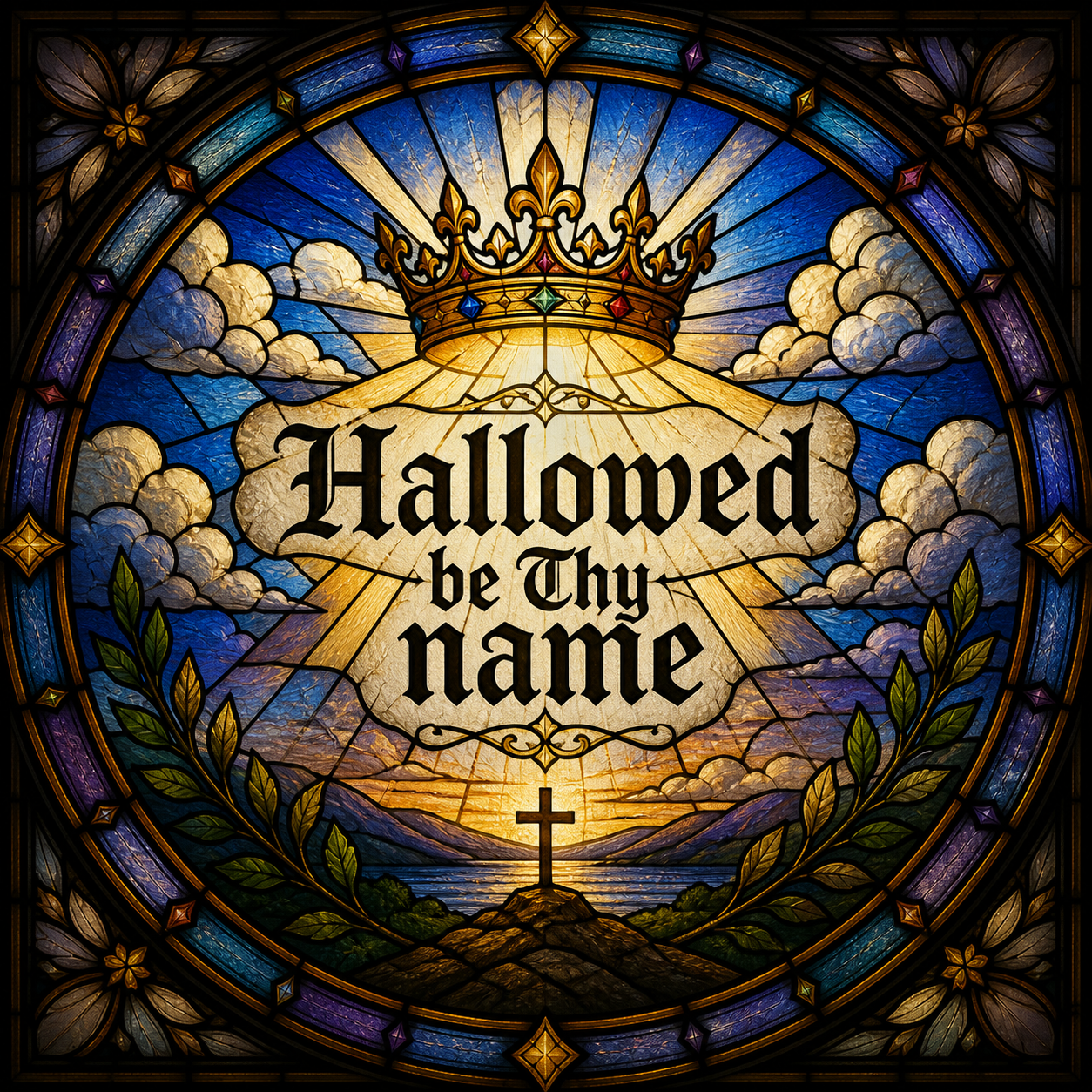
The Lord’s Prayer begins with the words:
“Our Father who art in heaven, Hallowed be Thy name.” (Matt 6:9 NAS)
This sets the tone for the entire prayer. Before asking for daily needs, petitions, or guidance, the focus is placed on God Himself. This opening request teaches us that sanctifying the name of God is the foundation of prayer and of life.
“But when he sees his children, the work of My hands, in his midst, They will sanctify My name; Indeed, they will sanctify the Holy One of Jacob, And will stand in awe of the God of Israel.” (Isa 29:23 NAS)
The phrase “hallowed be thy name” is simple, but it carries deep meaning. It calls us to approach God with the correct mindset that He is holy.
What does “Hallowed” mean?
The Greek word “hagiazo” means “to make holy,” “to consecrate,” or “to sanctify.” In simple terms, it speaks of setting something apart for God.
“For everything created by God is good, and nothing is to be rejected, if it is received with gratitude; for it is sanctified by means of the word of God and prayer.” (1Ti 4:4-5 NAS)
It’s not just about being morally clean, but about belonging to Him in a special way. When the word “hagiazo” is used in Scripture, it reminds us that God lovingly sets people apart for His purposes and calls them to reflect His character.
“By this will we have been sanctified through the offering of the body of Jesus Christ once for all.” (Heb 10:10 NAS)
To be “sanctified” is to be drawn closer to Him, shaped by His presence, and set aside to live in a way that honors His name. We are to live in the world as separate from the world’s desires and devoted to glorifying God. Jesus prayed,
“I do not ask Thee to take them out of the world, but to keep them from the evil one. They are not of the world, even as I am not of the world. Sanctify them in the truth; Thy word is truth.” (John 17:15-17 NAS)
God’s holiness is not something we give Him. It is something we acknowledge and live by. When we say “hallowed be thy name,” we are acknowledging God’s name to be honored in our hearts, our words, and throughout the world.
We honor God’s name with our words and actions. We are to speak of the Father with reverence and truth, whether in prayer or in public.
“Let your light shine before men in such a way that they may see your good works, and glorify your Father who is in heaven.” (Matt 5:16 NAS)
Our actions can bring honor or dishonor to God’s name. We honor His name in worship.
This is tied to the third Commandment.
God commands His people to treat His name with reverence. The third commandment says:
“You shall not take the name of the LORD your God in vain, for the LORD will not leave him unpunished who takes His name in vain.” (Exo 20:7 NAS)
When we take God’s name in vain, we misuse it by treating it lightly, speak irreverently, or act unbecoming of His sanctified servant.
“Bless the LORD, O my soul; And all that is within me, bless His holy name.” (Psa 103:1 NAS)
We are representatives of God and are to speak and act accordingly. It includes careless speech, false promises made in His name, and living in a way that dishonors Him.
“But the prophet who shall speak a word presumptuously in My name which I have not commanded him to speak, or which he shall speak in the name of other gods, that prophet shall die.” (Deu 18:20 NAS)
“Hallowed be thy name” is the positive expression of this command. Instead of misusing His name, we are called to honor it.
What Does “Thy Name” Mean?
In the Bible, a name is more than a label. It represents a person’s character, nature, and authority. God is not called only by one name. God reveals Himself through many names. Each name teaches us something true about who He is.
The name “Yahweh” is the “LORD.”
The word “Lord” can translate into several different Hebrew words. In Genesis chapter 28, for example, God refers to Himself as the “Lord” which translates as “Yahweh,” which is the proper name of the God of Israel.
“And behold, the LORD stood above it and said, “I am the LORD (Yahweh), the God of your father Abraham and the God of Isaac; the land on which you lie, I will give it to you and to your descendants.” (Gen 28:13 NAS)
The divine name Yahweh appears about 6,825 times in the Old Testament. It is represented in Hebrew by the four letters YHWH (often called the Tetragrammaton). “Yahweh,” however, is not used in the Bible until Genesis chapter 2.
“This is the account of the heavens and the earth when they were created, in the day that the LORD (Yahweh) God made earth and heaven.” (Gen 2:4 NAS)
Most English Bibles translate this name as “LORD” in all capital letters, rather than spelling out “Yahweh.” The words “LORD God” in Genesis 2:4 are “Yahweh Elohim.” The first name God used for Himself in the Bible is “Elohim.”
The Name “Elohim” is “God.”
The name God or “Elohim” appears at the very beginning of the Bible.
In the beginning God (Elohim) created the heavens and the earth. (Gen 1:1 NAS)
This name shows God as the most powerful creator of all things.
“For by Him all things were created, both in the heavens and on earth, visible and invisible, whether thrones or dominions or rulers or authorities– all things have been created by Him and for Him.” (Col 1:16 NAS)
He created all things; therefore, He is the only One who is to be glorified in our prayer and life. To hallow His name is to recognize Him as the source of life and to live in awe of His power.
The name “Hayah” is “I Am.”
When Moses was speaking to God in the burning bush, God said His name is “I Am.” The Hebrew word “Hayah” in English is “I Am.” In Exodus, God reveals this name to Moses. It speaks of His eternal nature. He has no beginning or end.
“Then Moses said to God, ‘Behold, I am going to the sons of Israel, and I shall say to them, The God of your fathers has sent me to you.’ Now they may say to me, ‘What is His name? What shall I say to them?’ And God said to Moses, ‘I AM WHO I AM’; and He said, ‘Thus you shall say to the sons of Israel, I AM has sent me to you.'” (Exo 3:13-14 NAS)
“I Am” simply means to be, self-exist and unchanging. To hallow God’s name is to honor His eternal existence.
“Now to the King eternal, immortal, invisible, the only God, be honor and glory forever and ever. Amen.” (1Ti 1:17 NAS)
This name reminds us that God is always present and always faithful. When we pray, “hallowed be thy name,” we are sanctifying Him as the only eternal God whose promises have no end.
“God and the knowledge of the truth which is according to godliness, in the hope of eternal life, which God, who cannot lie, promised long ages ago.” (Tit 1:1-2 NAS)
The Name “El Shaddai” is “God Almighty.”
The name “El Shaddai” or “God Almighty” is first used in Genesis chapter 17.
“I am God Almighty; Walk before Me, and be blameless.” (Gen 17:1 NAS)
This name emphasizes God’s strength and ability to do all He promises.
“But our God is in the heavens; He does whatever He pleases.” (Psa 115:3 NAS)
When we pray in His name knowing that by His singular authority, His eternal purposes will be fulfilled without fail.
“Remember the former things long past, For I am God, and there is no other; I am God, and there is no one like Me, Declaring the end from the beginning And from ancient times things which have not been done, Saying, ‘My purpose will be established, And I will accomplish all My good pleasure’; Calling a bird of prey from the east, The man of My purpose from a far country. Truly I have spoken; truly I will bring it to pass. I have planned it, surely I will do it.” (Isa 46:9-11 NAS)
The Name “Adonai” means “Lord.”
Adonai means “Lord” or “Master.” This name of God is first used in Genesis chapter 15.
“And Abram said, ‘O Lord God, what wilt Thou give me, since I am childless, and the heir of my house is Eliezer of Damascus?’” (Gen 15:2 NAS)
The standard Hebrew usage of the word throughout the Old Testament, the specific form Adonai is overwhelmingly used as a reverent title for God. In Psalm 8 we see “Yahweh” paired with “Adonai.”
“O Lord (Yahweh), our Lord (Adonai), How majestic is Thy name in all the earth, Who hast displayed Thy splendor above the heavens!” (Psa 8:1 NAS)
This name reminds us that God has authority over all creation and over our lives. To hallow His name is to submit to Him with reverence and obedience as the one true Lord. To pray, “Our Father who art in heaven, hallowed be Thy name,” is to acknowledge the only true God, the Creator, who exists eternally, sovereign over all things and Master over our lives.
The name of God is revealed in the promised Son.
The name of God is seen in the promise of the Messiah, Jesus Christ. Isaiah wrote,
“For a child will be born to us, a son will be given to us; And the government will rest on His shoulders; And His name will be called Wonderful Counselor, Mighty God, Eternal Father, Prince of Peace.” (Isa 9:6 NAS)
This is common throughout the Bible. When studying the Old Testament with the New Testament, it becomes clear the names of God are also applied to Jesus Christ. Yahweh, Adonai, Elohim, and Hayah are all attributed to Christ. For example, Joel wrote,
“And it will come about that whoever calls on the name of the LORD (Yahweh) Will be delivered.” (Joel 2:32 NAS)
Paul quotes Joel as being fulfilled in Christ.
“For there is no distinction between Jew and Greek; for the same Lord is Lord of all, abounding in riches for all who call upon Him; for ‘Whoever will call upon the name of the LORD will be saved.’” (Rom 10:12-13 NAS)
Isaiah wrote that every knee will bow to Yahweh.
“I have sworn by Myself, the word has gone forth from My mouth in righteousness and will not turn back, That to Me every knee will bow, every tongue will swear allegiance. They will say of Me, ‘Only in the LORD (Yahweh) are righteousness and strength.’ Men will come to Him, and all who were angry at Him shall be put to shame” (Isa 45:23-24 NAS)
Paul says that at the name of Jesus every knee should bow.
“At the name of Jesus every knee should bow, of those who are in heaven, and on earth, and under the earth, and that every tongue should confess that Jesus Christ is Lord, to the glory of God the Father.” (Phil 2:10-11 NAS)
Isaiah prophesied of a voice in the wilderness clearing the way for Yahweh.
“A voice is calling, ‘Clear the way for the LORD (Yahweh) in the wilderness; Make smooth in the desert a highway for our God.’” (Isa 40:3 NAS)
Mark quotes this as referring to John the Baptist clearing the way for Christ.
“The beginning of the gospel of Jesus Christ, the Son of God. As it is written in Isaiah the prophet, ‘Behold, I send My messenger before Your face, Who will prepare Your way; The voice of one crying in the wilderness, ‘Make ready the way of the Lord, Make His paths straight.'” (Mark 1:1-3 NAS)
Only God, Yahweh is the Lord of lords.
“For the LORD (Yahweh) your God (Elohim) is the God of gods and the Lord of lords, the great, the mighty, and the awesome God who does not show partiality, nor take a bribe.” (Deu 10:17 NAS)
John calls Jesus Lord of lords and King of kings, which is a reference to the Old Testament usage of the phrase.
“These will wage war against the Lamb, and the Lamb will overcome them, because He is Lord of lords and King of kings, and those who are with Him are the called and chosen and faithful.” (Rev 17:14 NAS)
Jesus said He is “I Am.”
“Jesus said to them, ‘Truly, truly, I say to you, before Abraham was born, I am.’” (John 8:58 NAS)
To hallow the name of God includes honoring the Son. This is one reason why we are to believe in and pray in the name of Christ.
“And this is His commandment, that we believe in the name of His Son Jesus Christ, and love one another, just as He commanded us.” (1John 3:23 NAS)
“And whatever you ask in My name, that will I do, that the Father may be glorified in the Son. If you ask Me anything in My name, I will do it.” (John 14:13-14 NAS)
The names of God reveal the depths of His character: eternal existence, sovereign power, boundless love, and unchanging faithfulness. Each name is not merely a title but a window into the divine, calling believers to worship the God who is both transcendent and near. From the ancient promise of a Messiah to the fulfillment in Jesus Christ, these names culminate in the revelation of God’s ultimate plan: salvation through His Son, who embodies all divine attributes.
To pray, “Hallowed be Thy name,” is to acknowledge God’s supremacy over all creation and to align one’s life with His eternal purposes. It is a call to reverence, obedience, and trust in a God who is both “I Am” and “Lord of lords,” whose promises are unshakable and whose love is incarnate in Jesus. Understanding these names deepens our relationship with God, reminding us that He is not distant but intimately involved in our lives, guiding, sustaining, and transforming us.