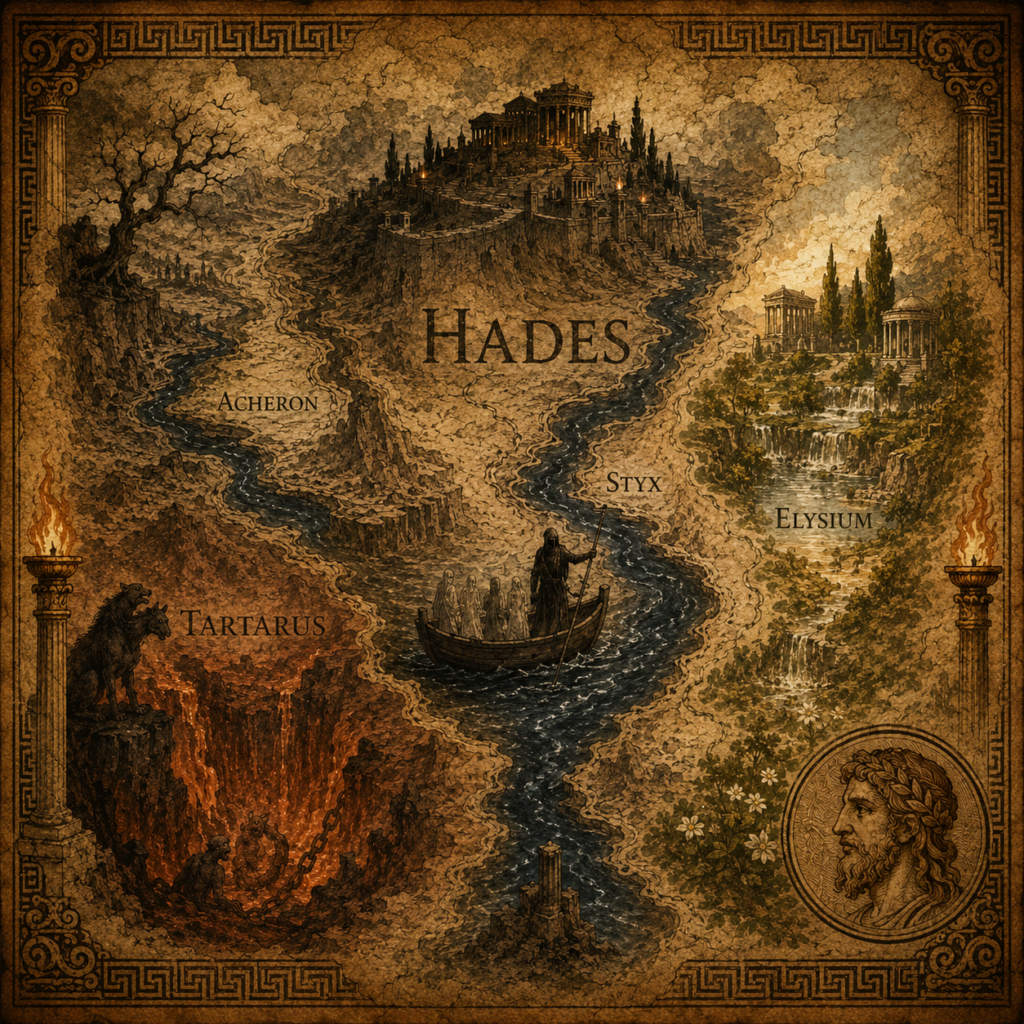
Hades, Charon, the Great Chasm, and the Biblical Message of the Rich Man and Lazarus
When modern Christians read the story of the rich man and Lazarus, we bring two thousand years of Christian teaching and imagery with us. A Greek-speaking person in the first-century Mediterranean world would have brought a very different cultural background.
Words such as Hades, burial, the dead, judgment, and an impassable boundary were already familiar. Greek stories had spoken about Hades and the journey of the dead for centuries. Charon, the ferryman who carried the dead across the underworld waters, was also well known by the classical period. Aristophanes could joke about Charon’s fare in The Frogs centuries before the New Testament because his audience already understood the reference.
Yet Jesus does not simply repeat Greek mythology. He uses language His hearers could understand and gives them an entirely biblical explanation of death, judgment, mercy, and salvation.
Hades Was Already Familiar Language
Long before the New Testament, Homer spoke about the “house of Hades” as the realm of the dead. In describing its geography, The Odyssey also mentions the rivers Acheron, Cocytus, Pyriphlegethon, and Styx.
Homer writes:
“There into Acheron flow Periphlegethon and Cocytus, which is a branch of the water of the Styx.”
Homer, Odyssey 10.513–514.
A Greek reader therefore did not encounter the word Hades as a new Christian word. It already belonged to the language of death and the underworld. Yet Greek-speaking Jews also knew the word from somewhere else: their Bible.
The Septuagint Had Already Made Hades a Biblical Word
The Hebrew Old Testament uses Sheol for the realm of death. When Jewish translators translated the Hebrew Scriptures into Greek centuries before Christ, they frequently used the Greek word ᾅδης (Hadēs) for Sheol. Consider Jacob mourning for Joseph.
The American Standard Version translates the Hebrew:
“And all his sons and all his daughters rose up to comfort him; but he refused to be comforted; and he said, For I will go down to Sheol to my son mourning. And his father wept for him.” Genesis 37:35 ASV
The Greek Septuagint says:
“And all his sons and his daughters gathered themselves together, and came to comfort him; but he would not be comforted, saying, I will go down to my son mourning to Hades; and his father wept for him.” Genesis 37:35 LXX, Brenton
The Hebrew Sheol had become Greek Hades. The connection becomes even clearer in Psalm 16 and Acts 2. Peter quotes the Greek form of the Psalm concerning Christ:
“Because thou wilt not leave my soul unto Hades, Neither wilt thou give thy Holy One to see corruption.” Acts 2:27 ASV
Peter was not teaching belief in the pagan god Hades. He was using the Greek biblical vocabulary already established by the Septuagint. So a Greek-speaking Jew hearing Hades could recognize two cultural layers at once. The word had an older Greek history, but it had also become ordinary biblical vocabulary for Sheol.
Now Listen to Luke 16 as a Greek-Speaking Hearer
Jesus says:
“Now there was a certain rich man, and he was clothed in purple and fine linen, faring sumptuously every day: and a certain beggar named Lazarus was laid at his gate, full of sores, and desiring to be fed with the crumbs that fell from the rich man’s table; yea, even the dogs came and licked his sores. “And it came to pass, that the beggar died, and that he was carried away by the angels to Abraham’s bosom: and the rich man also died, and was buried. “And in Hades he lifted up his eyes, being in torments, and seeth Abraham afar off, and Lazarus in his bosom.” Luke 16:19–23 ASV
The Greek-speaking hearer encounters several familiar ideas: death, burial, Hades, torment, and the condition of the dead. But then something very different happens. Lazarus is carried by angels.
Lazarus Needs No Ferryman
By the classical period, Greek culture knew the story of Charon, the ferryman associated with transporting the dead across the underworld waters. Aristophanes could write in The Frogs:
“The fare’s two obols.”
Aristophanes, The Frogs.
The Metropolitan Museum of Art notes that the obol became associated in Greek funerary belief with the payment given to Charon, who transported the dead across Styx or Acheron to Hades; coins were consequently associated with burial practice.
Now consider Lazarus. He is the poorest person in Jesus’ story. He lay helpless at the rich man’s gate, longing for the crumbs that fell from another man’s table. He has nothing with which to purchase anything. Then Lazarus dies.
Jesus does not give him Charon. He does not give him a coin. He does not give him a pagan river crossing.
“the beggar died, and… was carried away by the angels to Abraham’s bosom” Luke 16:22 ASV
God sends angels to carry Lazarus. The poor man who could buy nothing is carried freely by the servants of God. And where is he taken? To Abraham. Lazarus is received into Abraham’s bosom into Abraham’s embrace. The picture is not of a pagan god receiving him into an underworld kingdom. Father Abraham receives Lazarus like a member of the household.
This is where culturally familiar language gives way to unmistakably biblical theology.
The Rich Man Is Buried and in Hades
The rich man receives a very different description:
“and the rich man also died, and was buried. And in Hades he lifted up his eyes, being in torments” Luke 16:22–23 ASV
The contrast is striking. Lazarus dies and is carried away by angels to Abraham. The rich man dies and is buried, and in Hades lifts up his eyes. The man who possessed everything during earthly life cannot purchase a different outcome after death. Meanwhile the beggar who possessed nothing is carried freely into Abraham’s embrace.
Jesus has reversed their earthly conditions.
Then Comes the Great Chasm
The rich man calls to Abraham, and Abraham answers him:
“But Abraham said, Son, remember that thou in thy lifetime receivedst thy good things, and Lazarus in like manner evil things: but now here he is comforted and thou art in anguish. “And besides all this, between us and you there is a great gulf fixed, that they that would pass from hence to you may not be able, and that none may cross over from thence to us.” Luke 16:25–26 ASV
The Greek expression is χάσμα μέγα (chasma mega) a great chasm or gulf. A Greek-speaking hearer familiar with stories of the underworld could recognize the general idea of a boundary among the dead. Greek mythology had long spoken of Hades together with underworld rivers such as Acheron and Styx.
But Jesus never says that the chasm is Styx. There is no Charon ferrying anyone across it. In fact, Abraham specifically says that no one can cross it. The purpose of the chasm is clear from the passage itself: it fixes the distinction between the comfort of Lazarus and the judgment of the rich man.
They Can Still See and Speak to One Another
The chasm prevents crossing, but it does not prevent awareness. The rich man sees Abraham and Lazarus. He calls to Abraham. Abraham hears him and responds. This agrees with another biblical description of judgment:
“he also shall drink of the wine of the wrath of God, which is prepared unmixed in the cup of his anger; and he shall be tormented with fire and brimstone in the presence of the holy angels, and in the presence of the Lamb:” Revelation 14:10 ASV
Luke portrays the rich man in torment while seeing and speaking with Abraham. Revelation portrays the wicked being tormented in the presence of the Lamb and the holy angels. The separation is real and impassable, but Scripture does not describe judgment as complete absence from the righteous or from Christ.
Jesus Finally Points to Moses and the Prophets
The ending of the story tells us where Jesus wants His hearers to look for the truth. The rich man asks Abraham to send Lazarus to warn his brothers. Abraham answers:
“But Abraham saith, They have Moses and the prophets; let them hear them.” Luke 16:29 ASV
The rich man objects:
“And he said, Nay, father Abraham: but if one go to them from the dead, they will repent.” Luke 16:30 ASV
Abraham replies:
“And he said unto him, If they hear not Moses and the prophets, neither will they be persuaded, if one rise from the dead.” Luke 16:31 ASV
This is the theological anchor of the story. Jesus may speak in Greek. He may use the familiar Greek word Hades. His hearers may know pagan stories about Hades, Charon, rivers of the dead, and judgment. But Jesus does not send them to Homer. He does not send them to Greek mythology. He sends them to Moses and the Prophets.
Familiar Language, Different Theology
A first-century Greek-speaking reader could therefore hear something familiar in Luke 16 without concluding that Jesus was teaching Greek mythology.
The word Hades was familiar from Greek culture, but Greek-speaking Jews had also been reading it in the Septuagint as the translation of Sheol for generations. Stories of Charon made the transportation of the dead familiar, but Jesus gives Lazarus angels rather than a ferryman.
Greek mythology knew rivers and boundaries in Hades, but Jesus gives His hearers a great fixed chasm whose meaning is defined by Abraham: no one may cross from one condition to the other. Greek stories contained rulers and judges of the dead, but Jesus places the entire moral authority of the story in Moses and the Prophets.
The vocabulary may have sounded familiar. The theology is thoroughly biblical.
A Striking Reversal
There is also something deeply pastoral in the way Jesus tells the story. Lazarus had been poor, sick, hungry, and overlooked. At death he is not forgotten. Angels come for him, carry him away, and Father Abraham receives him into his embrace.
The rich man had wealth, clothing, food, and status. He receives a burial, but none of those earthly advantages can change his condition before God. Even if a Greek hearer remembered stories about a ferryman and a fare for the dead, the contrast would be striking. The poorest man in the story needs no payment at all. God Himself provides his passage through the ministry of angels.
Salvation is not something Lazarus purchases. He is received.
Conclusion
Luke 16 was spoken and preserved in a Greek-speaking world where words and images connected with death already had long cultural histories. Hades, Charon, underworld rivers, burial customs, judgment, and boundaries among the dead were not unfamiliar concepts. Homer and Aristophanes demonstrate that these ideas had been part of Greek culture centuries before the New Testament.
Yet Jesus does not teach the Greek mythology His hearers already knew.
The Septuagint had already taken the Greek word Hades and used it as biblical vocabulary for Sheol. Lazarus is carried not by Charon but by angels. He pays no fare but is freely received into Abraham’s embrace. The great chasm is not called Styx, and no ferryman can cross it. Finally, Abraham directs the living not to Greek mythology but to Moses and the Prophets.
This is the safest way to understand the cultural background of Luke 16. Jesus used language His hearers could understand, but He used that language to teach them the truth revealed in Scripture. The vocabulary was familiar. The message belonged to God.