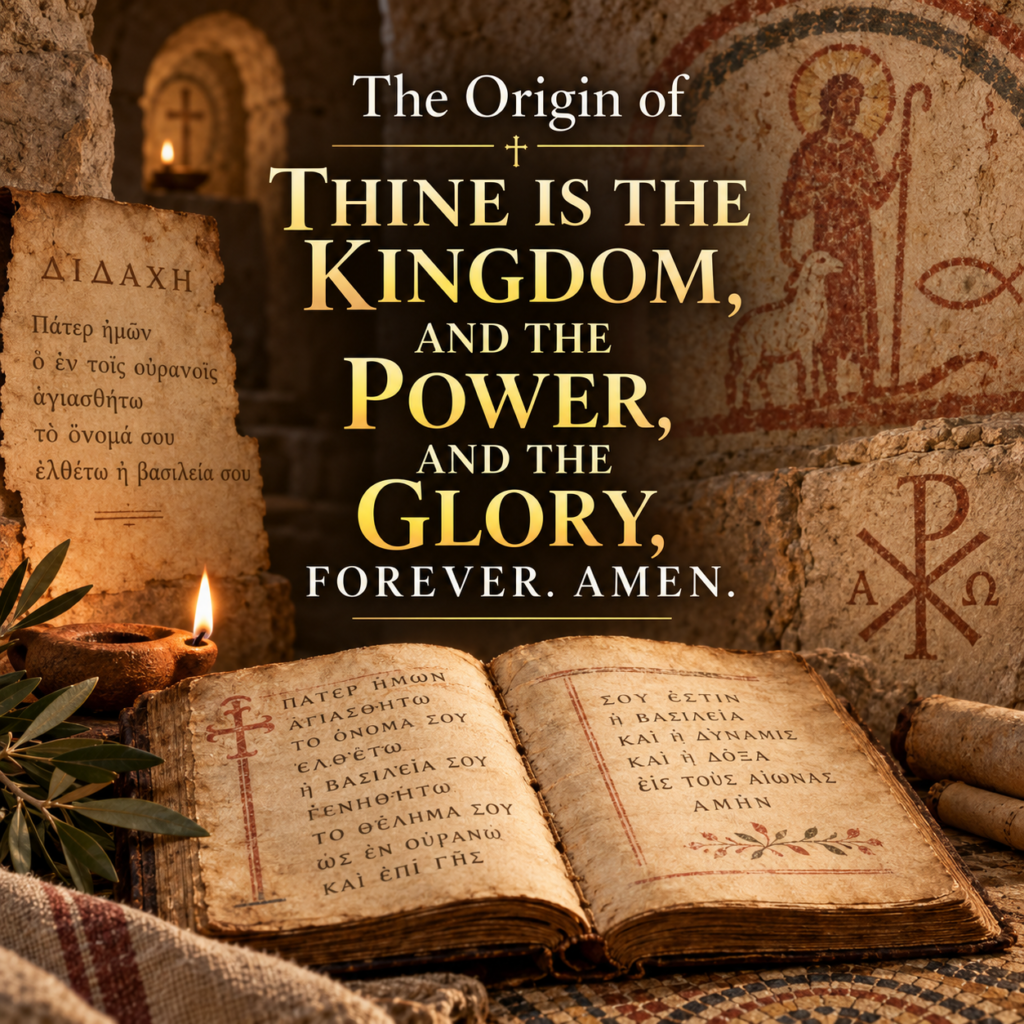
For many Christians, the Lord’s Prayer naturally ends with the familiar words, “For thine is the kingdom, and the power, and the glory, for ever. Amen.” These words appear in the King James Version and have been repeated in Christian worship for centuries. Yet many modern Bible translations place them in a footnote, enclose them in brackets, or omit them from Matthew 6:13 altogether.
An in depth analysis of The Doxology of the Lords Prayer can be downloaded here.
This raises a simple historical question: where did these words come from?
The answer is more complex than saying either that they were added at a late date or that modern translations removed them. Their history involves early Christian worship, ancient manuscripts, the Church Fathers, the Byzantine Greek tradition, the Textus Receptus, and the development of the English Bible.
The Doxology Is Very Ancient
The words did not originate with the King James Bible or with the Textus Receptus.
One of the earliest Christian writings outside the New Testament, the Didache, contains a form of the Lord’s Prayer that concludes, “For yours is the power and the glory forever.” The Didache is generally dated to the late first or early second century, which shows that a doxological ending was associated with the Lord’s Prayer very early in Christian history.
Its wording is not identical to the traditional English form because it does not include the phrase “the kingdom.” Nevertheless, it provides important historical evidence. Christians were using a doxological conclusion to the Lord’s Prayer many centuries before Erasmus produced his printed Greek New Testament in the sixteenth century.
The Greek Manuscripts Do Not All Agree
The surviving Greek manuscript tradition preserves more than one form of Matthew 6:13. Two important fourth-century manuscripts, Codex Vaticanus and Codex Sinaiticus, end the prayer with the petition “deliver us from evil” and do not contain the familiar doxology.
Many later Greek manuscripts, especially those associated with the Byzantine tradition, include the fuller wording: “For thine is the kingdom, and the power, and the glory, for ever. Amen.” Other ancient witnesses preserve shorter or slightly different forms.
The history should therefore not be reduced to a conflict between one completely uniform “Alexandrian Bible” and one completely uniform “Byzantine Bible.” Readings circulated in different forms, and over time the later Byzantine tradition came to preserve the full doxology with considerable consistency.
It is also important to distinguish the age of a manuscript from the age of the reading it contains. A later manuscript may preserve a very old reading, while an earlier manuscript may contain a scribal omission, alteration, or other variation. The date of a surviving copy does not by itself determine the date of every reading found within it.
The Church Fathers Reflect More Than One Form
The writings of the early Church Fathers also show that more than one form of the Lord’s Prayer was in circulation.
Augustine explains the prayer as ending with “deliver us from evil,” and Cyprian likewise discusses the petitions without the familiar doxology. John Chrysostom, however, writing in the late fourth century, clearly knew the fuller form. In his homily on Matthew, he discusses the words concerning God’s kingdom, power, and glory as part of the prayer.
This shows that the fuller doxology was already known and preached within Greek Christianity by the late fourth century.
The testimony of the Fathers is valuable, but it must be used carefully. Writers such as Eusebius, Athanasius, Augustine, and Chrysostom were not all working from one identical standardized Greek text. They used manuscripts available within their churches and regions, and their quotations must therefore be considered passage by passage rather than treated as evidence for an entire later textual tradition.
The Vulgate Does Not Contain the Doxology
Jerome’s Latin Vulgate is another important part of the history.
Jerome did not translate the New Testament from one identifiable Greek manuscript. Instead, he revised existing Old Latin Gospel texts by comparing them with Greek manuscripts available to him. At Matthew 6:13, the Vulgate ends with the words “but deliver us from evil” and does not include the traditional doxology.
This is significant because the familiar English wording did not pass into Protestant Bibles through the Latin Vulgate. Its principal path into the English tradition came through the Greek manuscript tradition.
Canon Recognition Is a Different Question
The history of the New Testament canon is sometimes confused with the history of the wording of the New Testament text, but these are separate questions.
Eusebius, Athanasius, and Augustine are important witnesses to the Church’s recognition of the books that came to form the New Testament. Athanasius, for example, provides the first surviving list containing exactly the twenty-seven books found in the modern New Testament.
Recognizing Matthew as Scripture, however, did not mean that every surviving manuscript of Matthew was identical in every word and phrase. The Church could recognize the Gospel according to Matthew as canonical while manuscripts of Matthew differed at individual readings.
Canon recognition concerns which books were received as Scripture. Textual criticism concerns the wording preserved within particular manuscripts and other early witnesses. Keeping those two questions distinct helps explain how the authority of Matthew could be firmly established even while textual variations continued to exist within copies of the Gospel.
The Byzantine Tradition Preserved the Full Form
By the medieval period, the Byzantine form of the Greek New Testament had become dominant among surviving Greek manuscripts. At Matthew 6:13, this tradition generally contains the full doxology: “For thine is the kingdom, and the power, and the glory, for ever. Amen.”
This does not mean that the doxology originated in the medieval period. The Didache and Chrysostom show that forms of it existed much earlier. What developed over time was the numerical dominance and increasing uniformity of the Byzantine textual tradition.
Erasmus and the Textus Receptus
In 1516, Desiderius Erasmus published one of the first printed Greek New Testaments. He worked from a small number of Greek manuscripts, most of them late and broadly Byzantine in character, and his text included the full doxology at Matthew 6:13.
Later Greek editions produced by Robert Estienne, Theodore Beza, and the Elzevir printers contributed to the printed Greek tradition that became known as the Textus Receptus.
The doxology therefore did not originate with the Textus Receptus. The printed editions inherited it from the Greek manuscript tradition available to their editors.
How the Words Entered the English Bible
The printed Greek New Testament had a major influence on early Protestant English translations. William Tyndale included the doxology in his New Testament, and the Geneva Bible and the Bishops’ Bible followed the same general textual tradition.
When the King James Version was produced in the early seventeenth century, its translators worked within this same broad Greek textual tradition and inherited the wording already familiar from earlier English translations. The Authorized Version gave English-speaking Christians the memorable form, “For thine is the kingdom, and the power, and the glory, for ever. Amen.”
Through the influence of the King James Bible and its use in Christian worship, the words became deeply rooted in English-speaking Christianity.
The general line of transmission may therefore be traced from early Christian prayer and Greek manuscript transmission through the Byzantine tradition, then into the printed Greek New Testament, the Textus Receptus, the Reformation-era English Bibles, and finally the King James Version. This explains how the familiar English wording reached later generations, but it does not describe the origin of the doxology itself, which is demonstrably much older.
Why Many Modern Bibles Treat the Words Differently
Modern Greek New Testaments give substantial weight to early manuscripts such as Vaticanus and Sinaiticus, together with ancient versions and patristic evidence. Because several important early witnesses do not contain the doxology, modern critical editions generally print Matthew 6:13 without it.
Translations based on those editions may omit the words from the main text, place them in brackets, or include them in a footnote. This does not indicate an attempt to remove the doctrines of God’s kingdom, power, or glory, since those teachings are found throughout Scripture.
At the same time, the traditional wording should not be dismissed as a late invention. The doxology has ancient Christian roots, and the fuller form was firmly established within the Greek manuscript tradition long before the Reformation.
The question, therefore, is not whether the theology of the doxology is biblical, but whether the full wording belonged to the earliest form of Matthew’s Gospel.
The Words Themselves Are Thoroughly Biblical
Whatever position one takes on the textual question, the theology of the doxology is plainly consistent with Scripture.
A particularly close Old Testament parallel appears in David’s prayer in 1 Chronicles 29:11: “Thine, O LORD, is the greatness, and the power, and the glory … thine is the kingdom, O LORD.” The same themes appear repeatedly throughout Scripture, where God’s rule, power, and glory are central to biblical worship.
The doxology therefore provides a natural theological conclusion to the Lord’s Prayer. The prayer begins with the holiness of God’s name and the coming of His kingdom, then moves through the needs of daily life, forgiveness, temptation, and deliverance. In its traditional form, it concludes by acknowledging that the kingdom and power belong to God and that glory is properly given to Him forever.
Conclusion
The familiar words “For thine is the kingdom, and the power, and the glory, for ever. Amen” did not originate with the King James Bible or with Erasmus.
A related doxological ending was already in use among Christians in the early centuries. The fuller form later became firmly established in the Byzantine Greek manuscript tradition, entered the printed Greek New Testament, and passed from there into the major Protestant English Bibles.
At the same time, important early manuscripts and ancient Christian writers preserve the Lord’s Prayer without the doxology. The historical evidence therefore does not support the simple claim that Erasmus added the words, nor does it justify ignoring the early evidence for the shorter form.
The doxology is ancient, thoroughly biblical in content, widely preserved in the Greek tradition, and deeply rooted in Christian worship. Its textual history is complex, but its theological language belongs naturally within the broader language of biblical prayer.
For readers who want to examine the manuscript evidence, the Church Fathers, the Vulgate, the history of the canon, the Byzantine tradition, the Textus Receptus, and the early English Bibles in greater detail, a longer documented study is available for download.