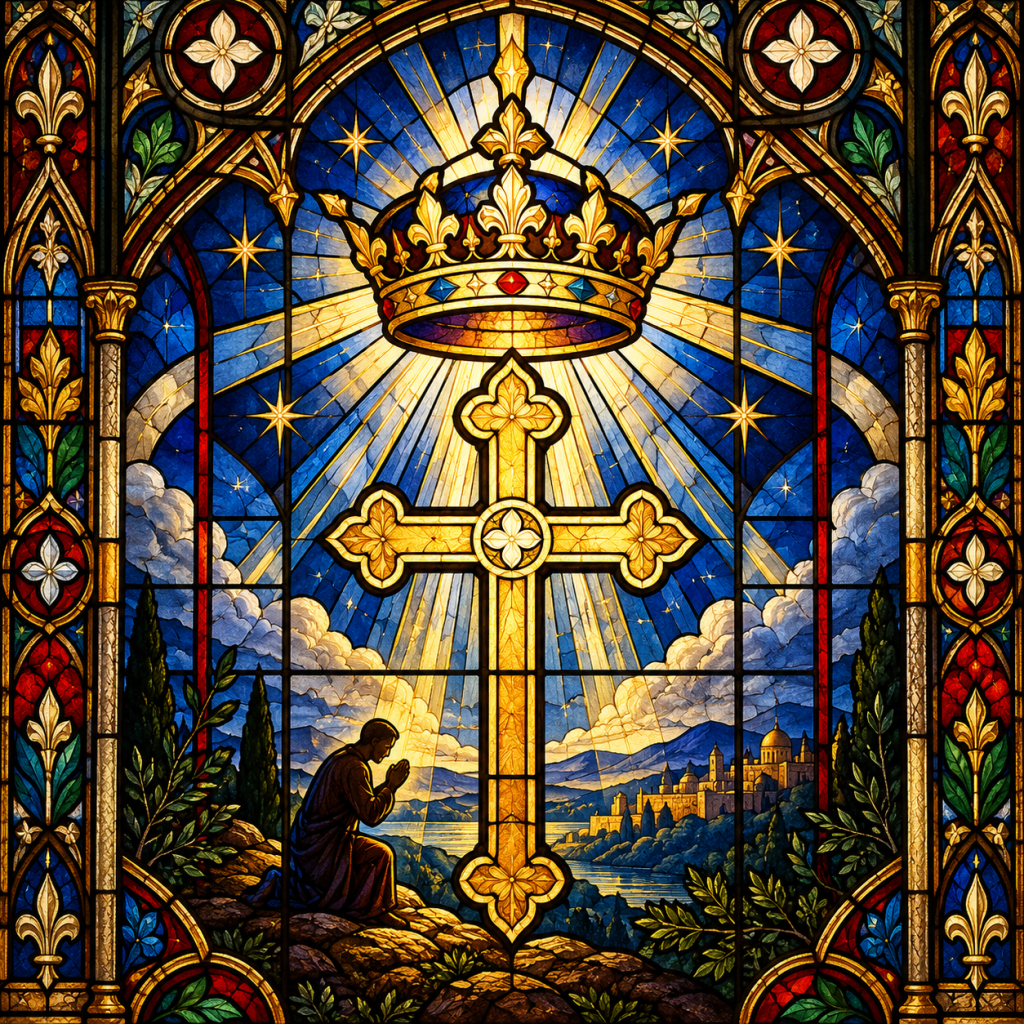
The traditional form of the Lord’s Prayer concludes:
“For Thine is the kingdom, and the power, and the glory, forever. Amen.” (Matthew 6:13)
After praying that God’s name be hallowed, His kingdom come, His will be done, daily needs be supplied, sins be forgiven, and deliverance from temptation and evil be granted, the person praying ends by confessing who God is. The closing words acknowledge His rule, His power to accomplish His will, and the glory that belongs to Him.
David used closely related language when he prayed:
“Thine, O LORD, is the greatness and the power and the glory and the victory and the majesty, indeed everything that is in the heavens and the earth; Thine is the dominion, O LORD, and Thou dost exalt Thyself as head over all.” (1 Chronicles 29:11 NASB)
The doxology is therefore consistent with the petitions that precede it. The person prays to God and then acknowledges why those petitions are properly addressed to Him: the kingdom belongs to Him, He possesses the power to accomplish His will, and the glory belongs to Him.
“Thine Is the Kingdom”
Earlier in the prayer, Jesus taught His disciples to ask, “Thy kingdom come” (Matt. 6:10). The words “Thine is the kingdom” affirm that the kingdom belongs to God. Biblical writers repeatedly identify God as King.
“The LORD has established His throne in the heavens; and His sovereignty rules over all.” (Psalm 103:19)
Daniel likewise declares,
“The Most High is ruler over the realm of mankind” (Dan. 4:17)
To say, “Thine is the kingdom,” is to acknowledge that ultimate authority belongs to God. The petition “Thy kingdom come” therefore does not ask God to establish a rule that does not yet belong to Him. It asks for the accomplishment and manifestation of His will under a kingship that is already His.
“The kingdom of the world has become the kingdom of our Lord and of His Christ; and He will reign forever and ever.” (Revelation 11:15 NASB)
A person who confesses that the kingdom belongs to God also acknowledges that his own authority is subordinate to God’s rule. A person cannot reasonably put his own desires, plans, loyalties, or decisions above God’s will. Prayer does not ask God to place His authority behind whatever the person already wants. It asks that His will be done and acknowledges His right to rule.
“And the Power”
The words “and the power” confess that God possesses the power necessary to accomplish His will. His rule is not merely an assertion of authority without the ability to act. Jeremiah prayed:
“Ah Lord GOD! Behold, Thou hast made the heavens and the earth by Thy great power and by Thine outstretched arm! Nothing is too difficult for Thee.” (Jeremiah 32:17 NASB)
This confession applies directly to the petitions that come before it. Depending upon God does not require passivity. A Christian may work to provide for daily needs, seek reconciliation, avoid circumstances that encourage temptation, and take reasonable steps to avoid danger or evil. Prayer and responsible action are not opposed to one another. The Christian may use ordinary means while recognizing that human ability is limited and that his ultimate dependence remains upon God.
“And the Glory”
Jesus began the Lord’s Prayer with the petition, “Hallowed be Thy name.” The words “and the glory” are consistent with that opening petition because they acknowledge that honor belongs to God.
“Not to us, O LORD, not to us, but to Thy name give glory because of Thy lovingkindness, because of Thy truth.” (Psalm 115:1)
The Lord’s Prayer includes real human needs: daily bread, forgiveness, protection from temptation, and deliverance from evil. Yet these needs are not the prayer’s highest purpose. The prayer begins with God’s name, His kingdom, and His will. Personal needs are therefore brought before God in submission to His purposes and for His glory. Jesus applies the same principle to human conduct:
“Let your light shine before men in such a way that they may see your good works, and glorify your Father who is in heaven.” (Matthew 5:16 NASB)
A Christian may properly seek provision, success in lawful work, vindication when falsely accused, opportunities to serve, and the ability to do good. But these things should not become a means of self-exaltation. The glory belongs to God, therefore what a Christian receives and accomplishes should be used in a way that honors Him.
“Forever. Amen.”
The word “forever” affirms the permanence of God’s rule. Human governments, institutions, circumstances, and rulers are temporary, but God’s dominion endures forever.
“Thy kingdom is an everlasting kingdom, and Thy dominion endures throughout all generations.” (Psalm 145:13)
The concluding “Amen” affirms both the petitions and the doxology. By saying “Amen,” he affirms these requests and his trust in the One whose kingdom, power, and glory endure forever.
“Amen” is more than a customary way to end a prayer. Scripture uses it as an expression of agreement with what has been spoken.
“And all the people shall answer and say, ‘Amen.’” (Deut. 27:15 NASB)
When a person concludes the Lord’s Prayer with “Amen,” he affirms its petitions: that God’s name be honored, His kingdom come, His will be done, and that he depends upon God for his daily needs, forgiveness, and deliverance from temptation and evil.
When God’s Answer Is No
The doxology also applies when God does not give what was requested. A Christian may bring his needs to God and ask for His help, while accepting that God’s answer may be no. Paul experienced this when he repeatedly asked the Lord to remove his affliction:
“Concerning this I implored the Lord three times that it might leave me. And He has said to me, ‘My grace is sufficient for you, for power is perfected in weakness.’ Most gladly, therefore, I will rather boast about my weaknesses, so that the power of Christ may dwell in me.” (2 Cor. 12:8–9 NASB)
To pray, “Thy will be done,” and then confess, “Thine is the kingdom, and the power, and the glory,” is to trust God even when His answer is not the one desired. A Christian may pray for provision and experience loss, ask for success and see his plans fail, or seek relief from hardship and find that it continues. God’s kingdom still stands, His power has not diminished, and His glory does not depend upon receiving the answer we want.
The traditional doxology therefore brings the Lord’s Prayer to a fitting conclusion. The Christian brings his needs before God while submitting them to God’s will. By saying “Amen,” he affirms the prayer even when God’s answer is no. God rules, God is able to act, and His kingdom, power, and glory endure forever.