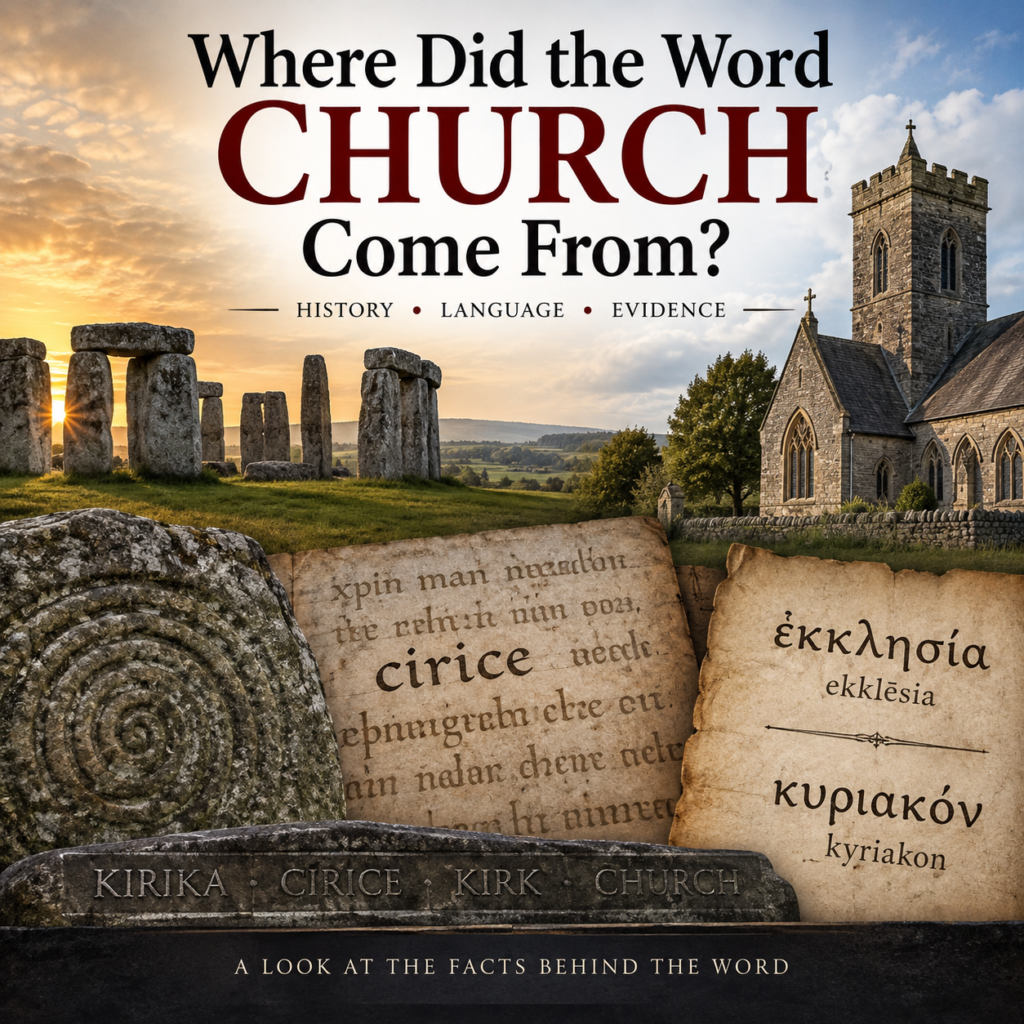
The English word church is so familiar that its history is easy to overlook. Today it can refer to a building, a local congregation, a denomination, an ecclesiastical institution, or even the act of attending worship. In English Bibles, church is also the usual translation of the Greek word ekklēsia. Yet church and ekklēsia are not historically the same word, and their meanings developed along different paths.
This raises an interesting question: Where did the word *church* actually come from?
An in depth analysis ofOrigins of the words Church, Kirk, Cirice, and Circle can be downloaded here.
One theory connects church and the related Scots word kirk with pre-Christian circular places of worship. According to versions of this theory, pagan worshippers gathered in circles, sometimes around a ritual fire, and Christians later adopted this existing religious terminology when pagan peoples were converted.
There are reasons this idea might initially sound plausible. Pre-Christian Britain contained circular monuments associated with ceremonial activity. Christians sometimes reused pagan sacred places and adapted existing customs. Much of the everyday language of pre-Christian Britain and Ireland is also poorly documented. But these facts do not establish that a word meaning “circle” became church. The historical and linguistic evidence points in a different direction.
Did Pagans Worship in Circles?
Prehistoric Britain certainly contained stone circles, henges, circular enclosures, and other monuments associated with ceremonial or sacred activity. Archaeology can tell us that such places existed and provide evidence concerning their probable uses.
What archaeology cannot tell us is what the people who used those places called them.
A circular religious monument does not establish that its users called it a “circle,” much less that their terminology eventually produced the English word church. That requires linguistic evidence.
The surviving ancient descriptions of Druidic religion are also important. Julius Caesar describes Druids conducting sacrifices and assembling annually at a consecrated place. He even reports the belief that Druidic teaching originated in Britain. Yet he says nothing about Druids worshipping in a circle.
Pliny the Elder gives a more detailed description of a Druidic ceremony involving a sacred oak and mistletoe. His account includes a feast, the sacrifice of two white bulls, prayer, and the ceremonial cutting of mistletoe. Again, there is no description of the participants worshipping in a circle.
Tacitus describes Druids during the Roman attack on Mona, modern Anglesey. He mentions Druids raising their hands toward heaven, invoking curses, women carrying torches, and sacred groves subsequently destroyed by the Romans. He likewise provides no evidence of circular worship.
This does not prove that no ancient pagan ever stood in a circle during a religious ceremony. It does mean that the ancient evidence examined here does not establish worship in a circle as a characteristic Druidic or British pagan practice.
The familiar image of Druids conducting ceremonies at Stonehenge is much later. Antiquarians such as John Aubrey and William Stukeley helped develop that association in the seventeenth and eighteenth centuries. Modern archaeology dates Stonehenge much earlier than the historically documented Druids.
Christians Did Reuse Pagan Places
There is, however, good evidence for another part of the theory: Christians sometimes repurposed existing pagan places and customs.
Around AD 601, Pope Gregory I instructed Mellitus concerning the conversion of the English. Gregory advised that suitable pagan temples should not necessarily be destroyed. Instead, idols could be removed, the places purified, Christian altars established, and familiar customs redirected toward Christian observance.
This is important because it demonstrates that Christianization did not always mean destroying every element of the previous culture. Places and customs could survive while acquiring different religious meanings.
But the reuse of a pagan sacred place does not establish the origin of the word used for the Christian building. Cultural continuity and linguistic descent are separate questions.
The Circle Theory Has Actually Been Proposed
The idea that church originated from a sacred circle is not new.
A. Hadrian Allcroft argued for something similar in his 1927–1930 work The Circle and the Cross. He proposed continuity between prehistoric sacred circles, circular churchyards, later Christian sacred sites, and even the word church itself.
Contemporary reviewers recognized his theory, but it did not become the accepted linguistic explanation. Modern historical dictionaries continue to trace the church/kirk family through another route.
The problem is straightforward: no early occurrence examined of *cirice*, *kirika*, or their related forms means “circle.”
The English word circle has a different documented history, belonging to the Latin circulus/circus family. The church/kirk family has its own history. Similarity in appearance or association with circular religious sites cannot establish that one descended from the other.
So Where Does Church Come From?
The historical word family includes:
- Old English: cirice
- Old Saxon: kirika
- Old High German: kirihha/chirihha
- Old Norse: kirkja
- Scots: kirk
- English: church
These forms belong to the same broad Germanic linguistic tradition.
The best-supported etymology connects this family with Late Greek kyrikon/kyriakon. Greek kyriakos means “of or belonging to the Lord,” and kyriakon could be used for “the Lord’s [house/place].”
This explanation is based on more than the words looking similar. Historical linguists examine sound changes, chronology, meanings, and the distribution of the different forms. The combined evidence makes kyrikon/kyriakon the strongest explanation for the origin of the Germanic word family.
There is still an uncertainty.
Older scholarship sometimes proposed that the word passed through Gothic Christianity before reaching western Germanic languages. The necessary Gothic form, however, has not survived. Other scholars have proposed western routes involving contact between Germanic speakers and Christians in the late Roman frontier regions, including the Rhineland and Trier.
Therefore, the evidence strongly supports the Greek source while the exact historical route by which the word entered West Germanic remains reconstructed.
That distinction matters. Historical reconstruction should not be presented as though someone found a document recording the moment the word was borrowed.
How Early Was Cirice Used in England?
The law code associated with King Æthelberht of Kent, traditionally dated around AD 600, contains ciricean in an explicitly Christian context alongside references to bishops, priests, deacons, and clerics.
The surviving manuscript is later, so we do not possess Æthelberht’s original parchment from AD 600. Nevertheless, the law-code tradition preserves very early Old English material.
By the early Anglo-Saxon Christian period, therefore, cirice was already established Christian vocabulary. What we do not possess is an earlier pagan text in which cirice means “circle” or describes pagan worship.
The absence of such evidence cannot prove that every possible earlier usage is impossible. But neither can a missing record be used to invent an earlier meaning. An unknown meaning is still unknown.
What About Kirk in Scotland?
The continued Scottish use of kirk can create another misunderstanding.
Scotland preserves both Germanic and Celtic linguistic traditions. Scots and Scottish Gaelic are not two versions of the same language. Scots belongs to the Germanic linguistic tradition, while Scottish Gaelic is Celtic.
That difference is visible in the words themselves:
- Scots: kirk → Germanic kirika/cirice family
- Scottish Gaelic: eaglais → Old Irish eclais → Latin ecclesia → Greek ekklēsia
Thus the survival of kirk in Scotland does not demonstrate that the word originated among earlier Celtic or Pictish peoples. The Celtic linguistic tradition actually preserves the ecclesia family instead.
Ekklēsia Is a Different Word
This brings us to an important biblical distinction.
Greek ekklēsia means an assembly or congregation. It could be used for civic assemblies, the assembly of Israel in the Septuagint, and Christian congregations in the New Testament. Acts 19 even uses ekklēsia for a non-Christian civic assembly.
It does not inherently mean a Christian building.
Over time, two linguistic histories overlapped.
Ekklēsia, and later Latin ecclesia, began with the assembly or community and could eventually refer to the place where that assembly met.
Cirice/kirika, by contrast, was strongly associated with the Christian worship place and eventually expanded to include the congregation, institution, clergy, denomination, and wider Christian body.
That helps explain why modern English church can mean both the building and the people who gather there.
Why English Bibles Say “Church”
English Bible translators did not invent the word church. Cirice existed centuries before the Reformation.
The important question is why church became the conventional English translation of ekklēsia.
William Tyndale deliberately preferred congregation. During his controversy with Thomas More, Tyndale argued that ekklēsia was not inherently a technical term for the institutional Christian Church. Its broader meaning was an assembly or gathering.
The issue became explicit when the King James Bible was prepared. Its translation rules instructed the translators to preserve traditional ecclesiastical terminology:
“The old ecclesiastical words to be kept, viz.: as the word ‘Church’ not to be translated ‘Congregation’ etc.”
Thus church rather than congregation was a conscious translation decision. The King James Bible did not create the word church. It helped preserve and reinforce its conventional association with Greek ekklēsia.
Why the Distinction Still Matters
Today church can mean a building, congregation, denomination, clergy, ecclesiastical institution, historical Christian body, or even attending a worship service.
That does not make church an automatically incorrect translation of ekklēsia. When church means Christian congregation, the English and Greek meanings overlap naturally.
The problem comes when meanings belonging to the later English word are read backward into the Greek. A New Testament occurrence of ekklēsia does not automatically imply a dedicated church building, denomination, clergy, or later ecclesiastical organization simply because modern English church can mean those things.
Conclusion
The evidence does not support deriving English church or Scots kirk from pagan circular worship or from a word meaning “circle.” Circular ceremonial monuments existed, and Christians sometimes reused pagan places and customs, but neither fact establishes the necessary linguistic connection.
The church/kirk family is represented historically by forms such as Old English cirice, Old Saxon kirika, Old High German kirihha, and Old Norse kirkja. The strongest linguistic evidence connects this family with Late Greek kyrikon/kyriakon, “the Lord’s [house/place],” although the exact route into West Germanic remains uncertain.
Greek ekklēsia has a different history. It denotes an assembly or congregation and became associated with church because church eventually became its conventional English translation, not because the two words share the same origin or identical range of meaning.
For readers who want the complete linguistic evidence, primary-source discussion, historical alternatives, and documentation, the full research paper can be linked here for further study.