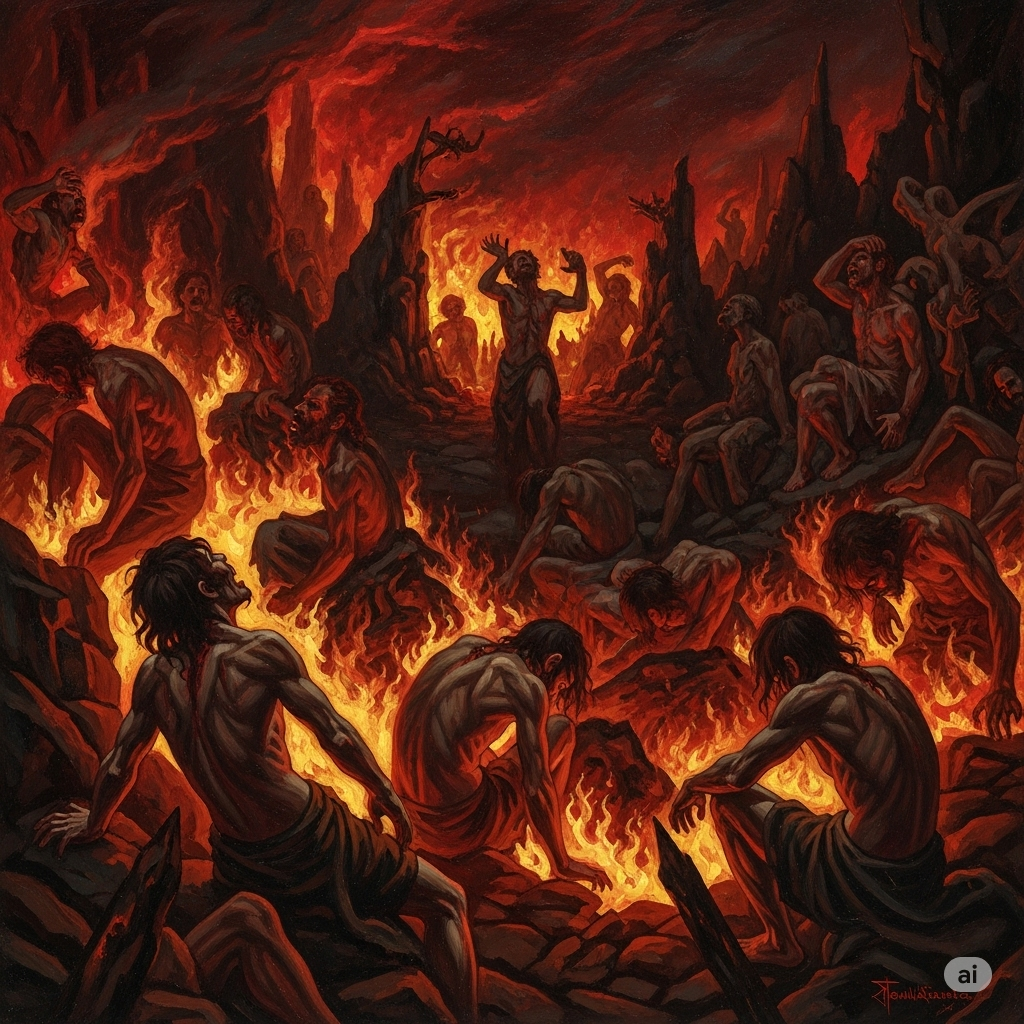
A Biblical Examination of Death, Judgment, Resurrection, and the Last Day
Christians have long asked what happens between a person’s death and the final resurrection. A common answer is that the soul enters an intermediate state and consciously remains there while earthly history continues until the future resurrection and Judgment Day.
This article considers whether Scripture actually requires such a waiting period.
The Bible clearly teaches that people die, that the dead will be raised, and that all will appear before Christ in judgment. It also repeatedly speaks of one Last Day, one resurrection of the dead, and judgment following death.
The question is therefore simple:
Does Scripture require us to believe that those who die consciously wait through the remaining centuries of earthly history before reaching the Last Day, or can death bring a person directly to the resurrection and judgment appointed by God?
Faithful Christians have understood these passages differently, so this question should be approached carefully. The purpose here is simply to follow the order Scripture gives us and avoid adding a period of waiting unless the biblical text requires it.
Scripture Shows an Unseen Reality Beyond Ordinary Human Perception
The Bible repeatedly shows that there are realities present around us that human eyes do not ordinarily perceive.
When Balaam traveled on the road, the angel of Jehovah was already standing before him. Balaam could not see the angel, although his donkey could. Scripture says:
“Then Jehovah opened the eyes of Balaam, and he saw the angel of Jehovah standing in the way, with his sword drawn in his hand; and he bowed his head, and fell on his face.” Numbers 22:31 ASV
The angel did not arrive when Balaam’s eyes were opened. Balaam was simply enabled to see what was already there. The same thing happened to Elisha’s servant:
“And Elisha prayed, and said, Jehovah, I pray thee, open his eyes, that he may see. And Jehovah opened the eyes of the young man; and he saw: and, behold, the mountain was full of horses and chariots of fire round about Elisha.” 2 Kings 6:17 ASV
The servant first saw only the earthly army. God then opened his eyes to a heavenly reality that was already surrounding them. These passages caution us against assuming that everything revealed about heaven, angels, death, and judgment must operate according to ordinary physical perception. Scripture describes a real unseen order that exists beyond what our eyes normally see. This becomes important when considering what happens at death.
Death Ends Our Participation in Earthly History
While we live in this world, we experience history one moment at a time. One generation follows another, years pass, nations rise and fall, and earthly history continues toward its appointed end. A man who dies in AD 100 dies at one point in that history. Another who dies in AD 1000 dies nine hundred years later. From the perspective of those still living on earth, those deaths are separated by centuries.
But Scripture never says that the person who died in AD 100 must continue experiencing those nine hundred earthly years after his death. Death ends his participation in earthly life. This does not mean that a human being becomes eternal or timeless as God is eternal. It simply means that we should not automatically assume that the earthly calendar continues to govern someone who is no longer living within earthly history.
That possibility helps explain the very simple order Scripture gives after death.
“After This Cometh Judgment”
Hebrews says:
“And inasmuch as it is appointed unto men once to die, and after this cometh judgment;” Hebrews 9:27 ASV
The stated order is straightforward:
Death is followed by judgment.
The verse does not describe centuries of conscious waiting between those events. Neither does it tell us that the dead continue experiencing earthly history until the world reaches Judgment Day. This verse alone does not answer every question concerning the dead, but it does establish the order Scripture wants us to remember: a person lives once, dies once, and afterward faces judgment.
If death ends a person’s participation in earthly history, then there is no difficulty in understanding how someone who dies many centuries before the end of the world can nevertheless be brought to the judgment that Scripture appoints after death.
Jesus Repeatedly Speaks of One Last Day
Jesus consistently places the resurrection of His people on the Last Day. He says:
“And this is the will of him that sent me, that of all that which he hath given me I should lose nothing, but should raise it up at the last day. For this is the will of my Father, that every one that beholdeth the Son, and believeth on him, should have eternal life; and I will raise him up at the last day.” John 6:39-40 ASV
Again:
“No man can come to me, except the Father that sent me draw him: and I will raise him up in the last day.” John 6:44 ASV
And again:
“He that eateth my flesh and drinketh my blood hath eternal life; and I will raise him up at the last day.” John 6:54 ASV
Martha expresses the same understanding concerning Lazarus:
“Martha saith unto him, I know that he shall rise again in the resurrection at the last day.” John 11:24 ASV
The language is remarkably consistent. The resurrection is associated with the Last Day, not with different final days for different generations of believers. Judgment is also associated with that day:
“He that rejecteth me, and receiveth not my sayings, hath one that judgeth him: the word that I spake, the same shall judge him in the last day.” John 12:48 ASV
The biblical picture therefore brings resurrection and judgment together at one final event.
How Can People Who Die Centuries Apart Reach the Same Last Day?
The difficulty appears only if we assume that the dead must continue experiencing the same timeline as those who remain alive on earth. Consider three people:
One dies in AD 100.
Another dies in AD 1000.
Another dies in AD 2000.
Their deaths occur at different points in earthly history. Yet Scripture reveals only one Last Day. There is no need to imagine that the person who died in AD 100 consciously waits nineteen hundred years for the person who dies in AD 2000. Those nineteen hundred years belong to the continuing history of the world.
Each person dies at his appointed time, leaves this earthly life, and can be brought to the same final event. This does not mean that Judgment Day gradually takes place over thousands of years. It means the opposite: there is one Judgment Day, while people leave earthly history from many different points and are gathered to that one day.
The Last Day remains future to us because we are still living within earthly history. That does not require the dead to remain somewhere watching that history pass.
Jesus Describes One Resurrection
Jesus says:
“Marvel not at this: for the hour cometh, in which all that are in the tombs shall hear his voice, and shall come forth; they that have done good, unto the resurrection of life; and they that have done evil, unto the resurrection of judgment.” John 5:28-29 ASV
Jesus speaks of the hour in which all who are in the tombs hear His voice. Their destinations differ, but the resurrection is described as one great event. Paul speaks similarly:
“having hope toward God, which these also themselves look for, that there shall be a resurrection both of the just and unjust.” Acts 24:15 ASV
These passages fit naturally with Christ’s repeated promise to raise His people on the Last Day. People die throughout many centuries of earthly history, but Scripture gathers the dead to one resurrection.
“To Depart and Be With Christ”
Paul’s words in Philippians are often used to support an intermediate state:
“But I am in a strait betwixt the two, having the desire to depart and be with Christ; for it is very far better:” Philippians 1:23 ASV
Paul clearly expected that departing this life would bring him to Christ. Nothing in the view presented here denies that. The question is whether Paul says that after departing he would spend centuries in a disembodied condition waiting for the resurrection. He does not.
Paul simply joins two thoughts: departing this life and being with Christ. If death brings the believer out of earthly history and to the final gathering of Christ’s people, then Paul’s words can be understood exactly as written. He departs and is with Christ. The passage establishes the believer’s destination. It does not establish a prolonged waiting period before resurrection.
“At Home With the Lord”
Paul expresses the same hope in 2 Corinthians:
“we are of good courage, I say, and are willing rather to be absent from the body, and to be at home with the Lord.” 2 Corinthians 5:8 ASV
The believer’s hope after leaving this mortal life is to be with the Lord. Notice where Paul’s argument soon leads:
“For we must all be made manifest before the judgment-seat of Christ; that each one may receive the things done in the body, according to what he hath done, whether it be good or bad.” 2 Corinthians 5:10 ASV
Paul speaks of leaving the present body, being with Christ, and appearing before Christ’s judgment seat in the same discussion. Nothing in the passage requires us to insert centuries of conscious waiting between those events.
What About the Souls Under the Altar?
Revelation 6 is often presented as clear evidence that deceased believers consciously wait for the final judgment:
“And when he opened the fifth seal, I saw underneath the altar the souls of them that had been slain for the word of God, and for the testimony which they held: and they cried with a great voice, saying, How long, O Master, the holy and true, dost thou not judge and avenge our blood on them that dwell on the earth? And there was given them to each one a white robe; and it was said unto them, that they should rest yet for a little time, until their fellow-servants also and their brethren, who should be killed even as they were, should have fulfilled their course.” Revelation 6:9-11 ASV
This passage deserves careful treatment. Revelation communicates through visions and symbols. John sees souls beneath an altar receiving white robes and crying out for justice. Elsewhere in Revelation he sees beasts, horns, seals, dragons, bowls, and other symbolic images.
The central message of this vision is clear: God has not forgotten the blood of His persecuted people, and their vindication will certainly come. What is less certain is whether John intends the vision to function as a literal description of the chronological experience of every believer between death and resurrection.
The passage can certainly be understood that way, and Christians who do so should be treated fairly. Yet because the vision is plainly apocalyptic and symbolic, it should not by itself be made the controlling description of the chronology of the dead when clearer passages repeatedly direct us toward the resurrection on the Last Day.
This View Is Not Soul Sleep
The interpretation presented here is also different from what is commonly called soul sleep. Soul sleep generally imagines that a person dies, remains unconscious while thousands of earthly years pass, and eventually awakens at the resurrection. But that still assumes that the dead person is passing through the same historical interval as the living world, only without being aware of it.
The view considered here is simpler. The person dies and no longer participates in earthly historical succession. The centuries that may pass on earth before the Last Day belong to those who remain within earthly history. Scripture does not require us to believe that the dead consciously or unconsciously pass through those same centuries.
Therefore, from the perspective of the person who dies, death can be followed by the event appointed after death: resurrection and judgment.
The Rich Man and Lazarus
Luke 16 also deserves consideration because both men die and immediately encounter very different conditions. Jesus says:
“And the poor man died, and he was carried away by the angels to Abraham’s bosom: and the rich man also died, and was buried. And in Hades he lifted up his eyes, being in torments, and seeth Abraham afar off, and Lazarus in his bosom.” Luke 16:22-23 ASV
Lazarus is carried away by the angels and received into Abraham’s embrace. The rich man dies, is buried, and in Hades lifts up his eyes in torment. Abraham then says:
“And besides all this, between us and you there is a great gulf fixed, that they that would pass from hence to you may not be able, and that none may cross over from thence to us.” Luke 16:26 ASV
The passage portrays judgment as immediate and fixed. The rich man does not enter a period in which his final condition remains undecided. Lazarus is received among the blessed, while the rich man experiences judgment. The purpose of this article is not to establish the complete geography of Luke 16. The important point here is that Jesus does not portray death as a long period of uncertainty before final consequences appear.
The Pastoral Importance
The question of the intermediate state is not merely an abstract theological puzzle. It concerns the hope Christians have when facing death. Paul wanted to “depart and be with Christ.” Jesus promised repeatedly to raise His people on the Last Day. Hebrews tells us that death is followed by judgment.
These truths can be held together without imagining the believer stranded in a temporary state for centuries while earthly history continues. For the Christian, death does not mean abandonment. Christ has conquered death, and the believer’s hope is to be with Him. For the unbeliever, the same truth is a solemn warning. Scripture does not offer death as another opportunity for repentance.
“And inasmuch as it is appointed unto men once to die, and after this cometh judgment;” Hebrews 9:27 ASV
The proper time to seek the mercy of God is therefore now.
Conclusion
Scripture clearly teaches death, resurrection, judgment, and the Last Day. Jesus repeatedly promises to raise His people on the Last Day and describes one coming hour in which those who are in the tombs hear His voice and come forth. What Scripture does not clearly describe is a long chronology after death in which the dead continue experiencing the passage of earthly centuries while waiting for that event.
The fact that one person dies centuries before another does not require them to experience different Judgment Days. Their deaths occur at different points within earthly history, but both can be brought to the same resurrection and judgment appointed by God. This interpretation does not require us to claim that human beings become timeless after death. It simply recognizes that Scripture never says the earthly calendar continues to govern those who have departed from earthly life.
Hebrews gives us the order: death, then judgment. Jesus gives us the destination of the resurrection: the Last Day. Paul gives us the believer’s hope: to depart and be with Christ. These teachings fit naturally together. Christians may continue to disagree about the precise condition of the dead, and Scripture does not answer every question we might ask. For that reason, this subject should be approached with humility.
But our hope does not rest in understanding every detail of what lies between death and resurrection. Our hope rests in Christ Himself, who has conquered death, who will raise the dead, and who will gather His people to Himself on the Last Day.