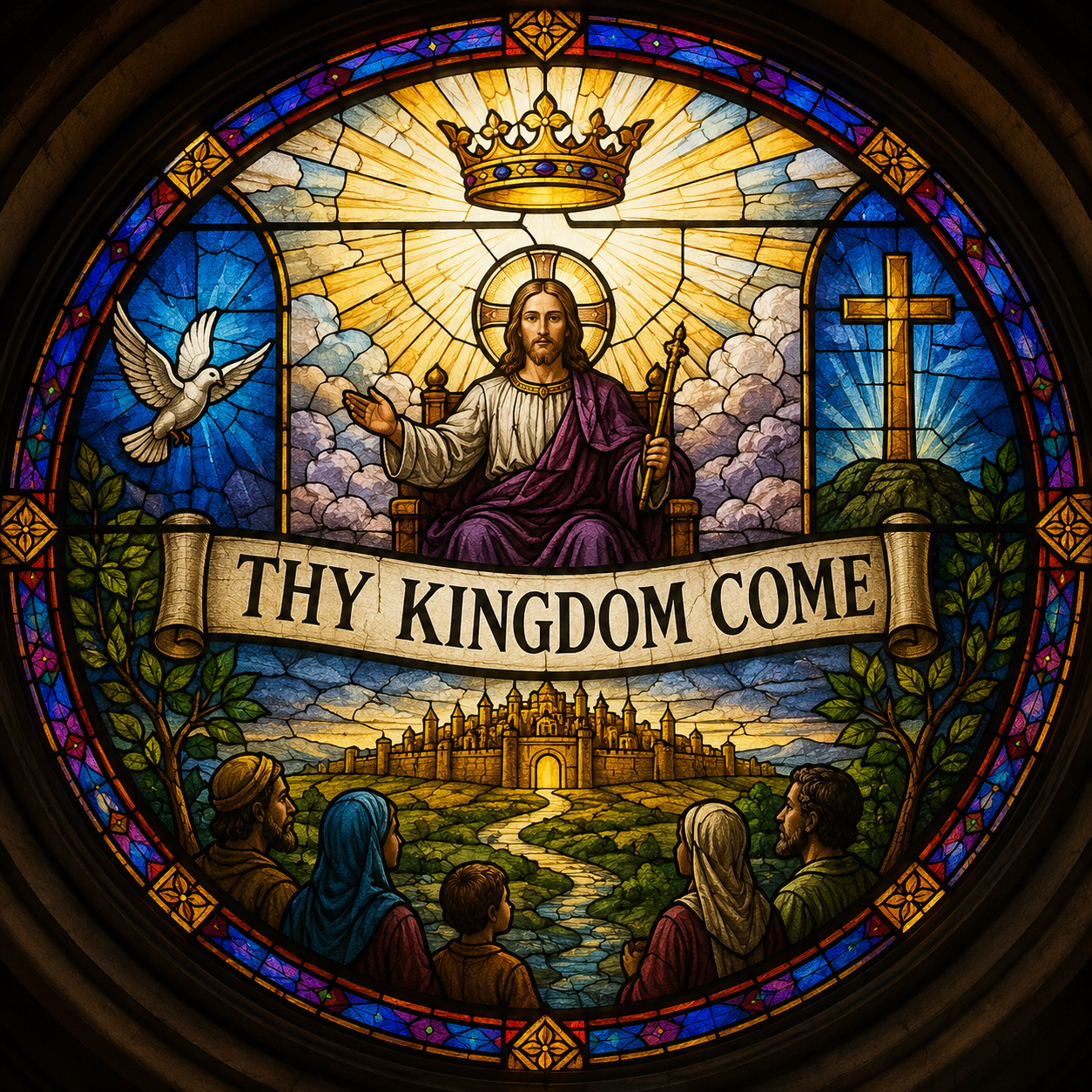
Throughout Scripture, the kingdom of God refers to God’s sovereign reign over His creation and His people. When Christians pray “Thy kingdom come,” they are acknowledging Christ as King, praying for the spread of the gospel, and desiring God’s will to be done on earth as it is in heaven. In the Lord’s Prayer, Jesus instructs us to pray,
“Our Father who art in heaven, Hallowed be Thy name. ‘Thy kingdom come. Thy will be done, On earth as it is in heaven.” (Matt 6:9-10 NAS)
He is teaching us to desire the fulfillment of God’s will and the advancement of His reign throughout the earth. These words point beyond earthly governments and political kingdoms to the spiritual rule of God.
“Jesus answered, ‘My kingdom is not of this world. If My kingdom were of this world, then My servants would be fighting, that I might not be delivered up to the Jews; but as it is, My kingdom is not of this realm.’” (John 18:36 NAS)
“For the kingdom of God is not eating and drinking, but righteousness and peace and joy in the Holy Spirit.” (Rom 14:17 NAS)
Because God’s kingdom is spiritual in nature, it cannot be entered through physical birth or human effort. Jesus taught that entrance into the kingdom requires a work of God within the heart, a new birth by the Spirit.
“Jesus answered and said to him, ‘Truly, truly, I say to you, unless one is born again, he cannot see the kingdom of God…’ That which is born of the flesh is flesh, and that which is born of the Spirit is spirit.’” (John 3:3-6 NAS)
Throughout Scripture, God’s kingdom is revealed through His sovereign rule, His covenant with Israel, the promises concerning the Messiah, and their fulfillment in Jesus Christ. Ultimately, “Thy kingdom come” is a prayer that people everywhere would acknowledge Jesus Christ as King and gladly live under His rule. It is a prayer that God’s reign would be increasingly manifested in human hearts, in the Church, and throughout the world.
God’s Kingdom Begins with Creation.
“In the beginning God created the heaven and the earth.” (Genesis 1:1)
The kingdom of God begins with creation itself. Because God is the Creator of all things, He possesses rightful authority over all that He has made. Scripture declares that His rule is not limited to a particular nation or place but extends over the entire universe.
“The LORD has established His throne in the heavens; And His sovereignty rules over all.” (Psa 103:19 NAS)
God’s sovereign authority over creation is not temporary or limited by time. He is the eternal King whose rule encompasses both the beginning and the end of all things.
“Now to the King eternal, immortal, invisible, the only God, be honor and glory forever and ever. Amen.” (1Ti 1:17 NAS)
God’s rule over creation forms the foundation of the prayer, “Thy kingdom come.” Before there was Israel, before there were prophets, and before Christ came into the world, God already reigned as King over all things.
God Revealed His Kingdom Through the Covenant with Israel.
After delivering Israel from Egypt, God established a covenant with them. He called them to be His holy people and promised that they would serve as a kingdom of priests if they remained faithful to Him.
“Now then, if you will indeed obey My voice and keep My covenant, then you shall be My own possession among all the peoples, for all the earth is Mine; and you shall be to Me a kingdom of priests and a holy nation. These are the words that you shall speak to the sons of Israel.” (Exo 19:5-6 NAS)
Although God had chosen Israel to be His people, they repeatedly turned away from Him. Eventually, they demanded an earthly king like the surrounding nations. In doing so, they rejected God’s direct rule over them.
“And the LORD said to Samuel, “Listen to the voice of the people in regard to all that they say to you, for they have not rejected you, but they have rejected Me from being king over them. “Like all the deeds which they have done since the day that I brought them up from Egypt even to this day– in that they have forsaken Me and served other gods– so they are doing to you also.” (1Sa 8:7-8 NAS)
When Christians pray, “Thy kingdom come,” they are acknowledging the same God who revealed His rule through His covenant with Israel and who faithfully carried out His plan of redemption throughout history.
The Prophets Foretold the Coming King.
After Israel rejected God’s rule, the prophets began speaking of a coming King who would establish God’s kingdom forever. God promised David that one of his descendants would inherit an everlasting throne.
“When your days are complete and you lie down with your fathers, I will raise up your descendant after you, who will come forth from you, and I will establish his kingdom. He shall build a house for My name, and I will establish the throne of his kingdom forever.” (2Sa 7:12-13 NAS)
The apostles taught that this promise was fulfilled in Jesus Christ. Peter declared that David’s prophecy pointed forward to the resurrection and reign of Christ.
“Brethren, I may confidently say to you regarding the patriarch David that he both died and was buried, and his tomb is with us to this day. “And so, because he was a prophet, and knew that God had sworn to him with an oath to seat one of his descendants upon his throne, he looked ahead and spoke of the resurrection of the Christ, that He was neither abandoned to Hades, nor did His flesh suffer decay. “This Jesus God raised up again, to which we are all witnesses.” (Acts 2:29-36 NAS)
The Psalms also speak of the Messiah as a King whose throne would endure forever and whose rule would be marked by righteousness.
“Thy throne, O God, is forever and ever; A scepter of uprightness is the scepter of Thy kingdom. Thou hast loved righteousness, and hated wickedness; Therefore God, Thy God, has anointed Thee With the oil of joy above Thy fellows.” (Psa 45:6-7 NAS)
The writer of Hebrews applies these words directly to Jesus, identifying Him as the eternal King.
“But of the Son He says, ‘Thy throne, O God, is forever and ever, And the righteous scepter is the scepter of His kingdom.’” (Heb 1:8 NAS)
The prophets also foretold how Israel’s King would reveal Himself to His people. Zechariah describes the King arriving in humility, riding on a donkey.
“Rejoice greatly, O daughter of Zion! Shout in triumph, O daughter of Jerusalem! Behold, your king is coming to you; He is just and endowed with salvation, Humble, and mounted on a donkey, Even on a colt, the foal of a donkey.” (Zec 9:9 NAS)
John presents Jesus’ entry into Jerusalem as the fulfillment of this prophecy, with the crowds recognizing Him as their King.
“‘Hosanna! Blessed is He who comes in the name of the Lord, even the King of Israel.’ And Jesus, finding a young donkey, sat on it; as it is written, ‘Fear not, daughter of Zion; behold, your King is coming, seated on a donkey’s colt.’” (John 12:12-15 NAS)
Isaiah likewise foretold the birth of a divine King whose reign would bring peace and whose kingdom would never end.
“For a child will be born to us, a son will be given to us; And the government will rest on His shoulders; And His name will be called Wonderful Counselor, Mighty God, Eternal Father, Prince of Peace. There will be no end to the increase of His government or of peace, On the throne of David and over his kingdom, to establish it and to uphold it with justice and righteousness from then on and forevermore. The zeal of the LORD of hosts will accomplish this.” (Isa 9:6-7 NAS)
Luke connects this promise directly to Jesus, declaring that He would inherit David’s throne and reign forever.
“He will be great, and will be called the Son of the Most High; and the Lord God will give Him the throne of His father David; and He will reign over the house of Jacob forever; and His kingdom will have no end.” (Luke 1:32-33 NAS)
The prophets looked forward to the coming King through whom God’s kingdom would be established. Every promise concerning the Messiah helps us understand what we are asking when we pray, “Thy kingdom come.”
Jesus Is the King of Israel.
The New Testament consistently presents Jesus as the promised King foretold by the prophets. From His birth to His crucifixion, those who encountered Him identified Him as the King of Israel. At Jesus’ birth, the magi came seeking the One they called the King of the Jews.
“Where is He who has been born King of the Jews? For we saw His star in the east, and have come to worship Him.” (Matt 2:2 NAS)
Later, Nathanael openly confessed that Jesus was both the Son of God and the King of Israel.
“Nathanael answered Him, ‘Rabbi, You are the Son of God; You are the King of Israel.’” (John 1:49 NAS)
Even during His trial before Pilate, the central question concerned His kingship. When Pilate asked whether He was the King of the Jews, Jesus affirmed the claim.
“And Pilate asked Him, saying, ‘Are You the King of the Jews?’ And He answered him and said, ‘It is as you say.’” (Luke 23:3 NAS)
To pray, “Thy kingdom come,” is first to acknowledge that Jesus Christ is King. The kingdom cannot be separated from the King who reigns over it. The New Testament consistently presents Jesus as the promised Messiah, the Son of David, and the rightful King of God’s people. Therefore, when Christians pray, “Thy kingdom come,” they are praying that people everywhere would acknowledge Jesus Christ as King and gladly live under His rule.
Jesus Announced the Kingdom of God.
The Kingdom of God was not presented as a distant reality reserved only for the future. Jesus spoke of God’s kingdom as something that had arrived through His own ministry and was actively at work among His people.
“And after John had been taken into custody, Jesus came into Galilee, preaching the gospel of God, and saying, ‘The time is fulfilled, and the kingdom of God is at hand; repent and believe in the gospel.’” (Mark 1:14-15 NAS)
Jesus taught that those who hear His voice receive life through Him, demonstrating the present power of God’s kingdom.
“Truly, truly, I say to you, an hour is coming and now is, when the dead shall hear the voice of the Son of God; and those who hear shall live.” (John 5:25 NAS)
When Jesus proclaimed that the Kingdom of God was at hand, He revealed that God’s saving reign was breaking into the world through His ministry. Therefore, “Thy kingdom come” is not merely a prayer about the future, but a recognition of Christ’s present reign.
Preaching the gospel is tied to the kingdom of God.
Throughout His ministry, Jesus connected the Kingdom of God with the preaching of the gospel. The message of the kingdom is not merely information; it is God’s means of transforming lives, bringing people to repentance, faith, and spiritual renewal.
“And Jesus was going about in all Galilee, teaching in their synagogues, and proclaiming the gospel of the kingdom, and healing every kind of disease and every kind of sickness among the people.” (Matt 4:23 NAS)
Jesus also taught that this message was not limited to Israel. The gospel of the kingdom was to be proclaimed throughout the entire world as a witness to all nations.
“And this gospel of the kingdom shall be preached in the whole world for a witness to all the nations, and then the end shall come.” (Matt 24:14 NAS)
Because the kingdom advances through the preaching of the gospel, praying “Thy kingdom come” includes a desire for the salvation of the lost and the spread of Christ’s reign throughout the earth.
“And when they had set a day for him, they came to him at his lodging in large numbers; and he was explaining to them by solemnly testifying about the kingdom of God, and trying to persuade them concerning Jesus, from both the Law of Moses and from the Prophets, from morning until evening.” (Acts 28:23 NAS)
The apostles continued Christ’s mission by proclaiming the kingdom and persuading people concerning Jesus. This same responsibility has been entrusted to believers today.
“I solemnly charge you in the presence of God and of Christ Jesus, who is to judge the living and the dead, and by His appearing and His kingdom: preach the word; be ready in season and out of season; reprove, rebuke, exhort, with great patience and instruction.” (2Ti 4:1-2 NAS)
Praying “Thy kingdom come” is more than acknowledging Christ as King; it is a desire that His rule would be recognized and embraced throughout the world. Just as God called Israel to live under His authority, Christians pray that all people would willingly submit to Christ, trust in Him, and walk according to His will. The petition is closely connected to the words that follow: “Thy will be done, on earth as it is in heaven.” God’s kingdom is seen wherever His reign is acknowledged, His gospel is believed, and His will is obeyed. When Christians pray these words, they are asking that God’s rule would be increasingly manifested in their own, in His Church, and throughout the world.