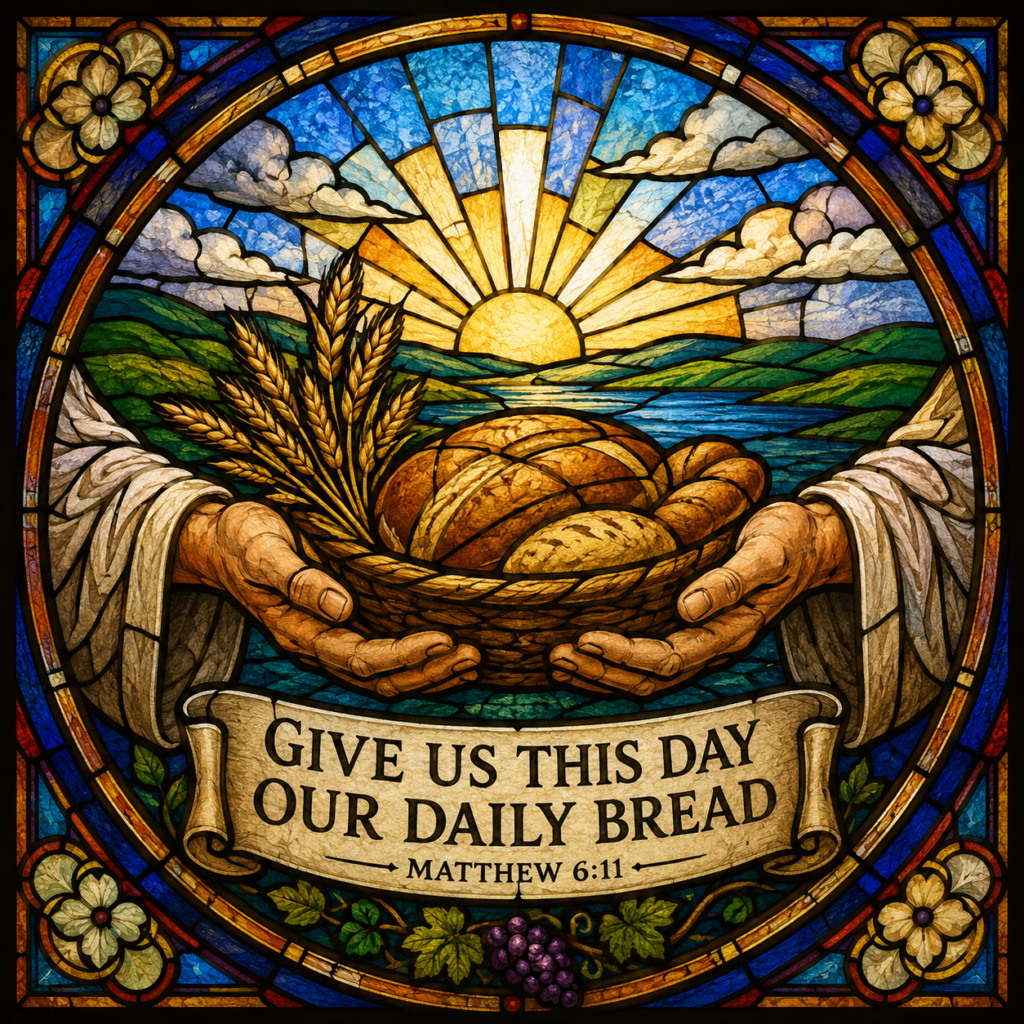
When Jesus taught His disciples to pray, He included a simple yet profound request:
‘Give us this day our daily bread. (Matt 6:11 NAS)
At first glance, these words appear to be a request for food. While they certainly include our physical needs, the rest of Scripture reveals that this petition reaches much deeper. It teaches us to depend on God for every necessity of life; physical, spiritual, and eternal. It is a prayer of trust, humility, contentment, and continual reliance upon our heavenly Father.
The Lord’s Prayer begins by directing our attention toward God:
“Pray, then, in this way: ‘Our Father who art in heaven, Hallowed be Thy name. Thy kingdom come. Thy will be done, On earth as it is in heaven.’” (Matt 6:9-10 NAS)
Only after seeking God’s glory and His kingdom does Jesus teach us to ask for our own needs. This order reminds us that God comes first, while our needs are placed into His loving care.
God Is the provider of every good thing.
The request, “Give us this day our daily bread,” begins with the recognition that God is the source of everything we possess.
James writes,
“Every good thing bestowed and every perfect gift is from above, coming down from the Father of lights, with whom there is no variation, or shifting shadow.” (James 1:17 NAS)
Whether we have food, clothing, shelter, health, strength, or opportunity to work, every blessing ultimately comes from God.
King David acknowledged this truth when he prayed,
“The eyes of all look to Thee, And Thou dost give them their food in due time. Thou dost open Thy hand, And dost satisfy the desire of every living thing.” (Psa 145:15-16 NAS)
Even creation itself depends upon God’s continual provision.
“They all wait for Thee, To give them their food in due season.” (Psa 104:27 NAS)
Our daily bread is therefore not merely the result of human effort. Although God commands people to labor diligently, it is God who provides the ability, opportunity, and blessing.
Moses reminded Israel,
“But you shall remember the LORD your God, for it is He who is giving you power to make wealth, that He may confirm His covenant which He swore to your fathers, as it is this day.” (Deut 8:18 NAS)
Everything we receive comes from His gracious hand.
We depend upon God daily.
Jesus specifically says, “Give us this day our daily bread.”
The emphasis is on daily dependence. God taught Israel this lesson during their journey through the wilderness. After delivering them from Egypt, He provided manna from heaven. The Lord said,
“Then the LORD said to Moses, “Behold, I will rain bread from heaven for you; and the people shall go out and gather a day’s portion every day, that I may test them, whether or not they will walk in My instruction.” (Exo 16:4 NAS)
Israel was forbidden from storing extra manna for future days, except before the Sabbath (Exodus 16:19-30). If they attempted to hoard it, the manna spoiled. God was teaching His people to trust Him one day at a time. Moses later explained the lesson:
“And He humbled you and let you be hungry, and fed you with manna which you did not know, nor did your fathers know, that He might make you understand that man does not live by bread alone, but man lives by everything that proceeds out of the mouth of the LORD.” (Deut 8:3 NAS)
Jesus quoted this very passage when Satan tempted Him in the wilderness.
“And the tempter came and said to Him, ‘If You are the Son of God, command that these stones become bread.’ But He answered and said, ‘It is written, ‘Man shall not live on bread alone, but on every word that proceeds out of the mouth of God.'” (Matt 4:3-4 NAS)
Physical bread sustains earthly life, but God’s Word sustains life in its fullest sense. Therefore, when we pray for daily bread, we acknowledge our daily dependence upon God just as Israel depended upon Him every morning.
Trust God and do not worry.
Immediately after teaching the Lord’s Prayer, Jesus explains why we should confidently ask for daily bread. He says,
“Do not be anxious then, saying, ‘What shall we eat?’ or ‘What shall we drink?’ or ‘With what shall we clothe ourselves?’ “For all these things the Gentiles eagerly seek; for your heavenly Father knows that you need all these things.” (Matt 6:31-32 NAS)
Jesus points to God’s care for birds.
“Look at the birds of the air, that they do not sow, neither do they reap, nor gather into barns, and yet your heavenly Father feeds them. Are you not worth much more than they?” (Matt 6:26 NAS)
The conclusion is clear:
“But seek first His kingdom and His righteousness; and all these things shall be added to you.” (Matt 6:33 NAS)
Our daily bread is given as we trust our heavenly Father rather than living in anxious fear. Jesus finishes by saying,
“So do not worry about tomorrow; for tomorrow will care for itself. Each day has enough trouble of its own.” (Matthew 6:34)
This perfectly matches the prayer for “this day” our daily bread. God calls us to trust Him today.
We are to be content with God’s provision.
Praying for daily bread also teaches contentment. The prayer does not ask for abundance, luxury, or earthly riches. It asks for enough. This principle appears throughout Scripture. Proverbs says,
“Keep deception and lies far from me, Give me neither poverty nor riches; Feed me with the food that is my portion, Lest I be full and deny Thee and say, “Who is the LORD?” Or lest I be in want and steal, And profane the name of my God.” (Prov 30:8-9 NAS)
Similarly, Paul writes,
“And if we have food and covering, with these we shall be content.” (1Ti 6:8 NAS)
The Christian learns to receive God’s provision with thanksgiving rather than constantly craving more. Paul also says,
“And my God shall supply all your needs according to His riches in glory in Christ Jesus.” (Phil 4:19 NAS)
Notice the promise concerns our needs, not every desire. Daily bread reminds us that God faithfully provides what is necessary for accomplishing His will.
We trust God and do not blame others.
When Jesus teaches us to pray, “Give us this day our daily bread,” He directs our hearts toward trusting God for today’s provision. Rather than looking backward in bitterness or blaming others for our circumstances, believers are called to look to their heavenly Father for what they need today.
The Lord rebuked Israel for using the proverb,
“What do you mean by using this proverb concerning the land of Israel saying, ‘The fathers eat the sour grapes, But the children’s teeth are set on edge’?” (Eze 18:2 NAS)
The people believed they were suffering only because of the sins of previous generations. God rejected this excuse and reminded them that every individual is responsible before Him for his own life.
“The person who sins will die. The son will not bear the punishment for the father’s iniquity, nor will the father bear the punishment for the son’s iniquity; the righteousness of the righteous will be upon himself, and the wickedness of the wicked will be upon himself.” (Eze 18:20 NAS)
While the consequences of sin may affect families and nations, every person is responsible before God for his own life. Rather than living in continual blame toward parents, ancestors, or others, believers are called to seek the Lord, who faithfully provides for His children.
The prayer, “Give us this day our daily bread,” turns our eyes away from resentment over the past and toward confidence in God’s present provision. Our hope is not found in what others should have done for us, but in what our heavenly Father graciously gives us today.
Our daily bread Points to Christ.
Although Jesus teaches us to pray for physical provision, bread throughout Scripture also points to something greater. Jesus declared,
“Jesus said to them, “I am the bread of life; he who comes to Me shall not hunger, and he who believes in Me shall never thirst.” (John 6:35 NAS)
Again, He says,
“I am the living bread that came down out of heaven; if anyone eats of this bread, he shall live forever; and the bread also which I shall give for the life of the world is My flesh.” (John 6:51 NAS)
The manna in the wilderness pointed forward to Christ. Jesus explained,
“Jesus therefore said to them, “Truly, truly, I say to you, it is not Moses who has given you the bread out of heaven, but it is My Father who gives you the true bread out of heaven.” (John 6:32 NAS)
Physical bread sustains the body for a time. Christ gives eternal life. Jesus says,
“This is the bread which came down out of heaven; not as the fathers ate, and died, he who eats this bread shall live forever.” (John 6:58 NAS)
Therefore, every time believers pray for daily bread, they are reminded that their greatest need is not merely physical food but continual life in Christ, who alone gives eternal salvation.
We Live by God’s Word.
Bread also reminds us of God’s Word. As Moses taught,
“And He humbled you and let you be hungry, and fed you with manna which you did not know, nor did your fathers know, that He might make you understand that man does not live by bread alone, but man lives by everything that proceeds out of the mouth of the LORD.” (Deut 8:3 NAS)
Jesus repeated these words in Matthew 4:4. Just as our bodies require daily nourishment, our souls require continual nourishment from God’s Word. Jeremiah declared,
“Thy words were found and I ate them, And Thy words became for me a joy and the delight of my heart; For I have been called by Thy name, O LORD God of hosts.” (Jer 15:16 NAS)
Job likewise said,
“I have not departed from the command of His lips; I have treasured the words of His mouth more than my necessary food.” (Job 23:12 NAS)
Daily bread therefore reminds believers to seek daily spiritual nourishment through God’s revealed Word.
God’s Provision Is Meant to Be Shared.
The prayer says, “Give us this day our daily bread.” It is not merely “give me.” The believer prays as part of God’s family. Scripture repeatedly teaches that those who receive God’s provision should care for others. Isaiah writes,
“Is it not to divide your bread with the hungry, And bring the homeless poor into the house; When you see the naked, to cover him; And not to hide yourself from your own flesh?” (Isa 58:7 NAS)
Jesus taught,
“Give, and it will be given to you; good measure, pressed down, shaken together, running over, they will pour into your lap. For by your standard of measure it will be measured to you in return.” (Luke 6:38 NAS)
Paul instructed believers,
“Let him who steals steal no longer; but rather let him labor, performing with his own hands what is good, in order that he may have something to share with him who has need.” (Eph 4:28 NAS)
God’s blessings are not meant to terminate upon ourselves. As God provides for us, we become instruments of His provision for others.
We give Thanks for Daily Provision.
Receiving daily bread should always produce gratitude. Paul writes,
“In everything give thanks; for this is God’s will for you in Christ Jesus.” (1Th 5:18 NAS)
Likewise,
“And whatever you do in word or deed, do all in the name of the Lord Jesus, giving thanks through Him to God the Father.” (Col 3:17 NAS)
Jesus Himself consistently gave thanks before distributing bread. Every meal reminds believers of God’s faithfulness and kindness.
The simple request, “Give us this day our daily bread,” contains a lifetime of instruction.
It teaches that God alone is the provider of every good gift. It calls us to daily dependence rather than anxious worry. It reminds us to be content with God’s provision, to trust Him one day at a time as Israel trusted Him for manna, and to recognize that our deepest need is fulfilled in Jesus Christ, the true Bread of Life.
Finally, this petition teaches that life is not sustained merely by physical food, but by every word that comes from God. As our heavenly Father faithfully provides both physical nourishment and spiritual life, believers are called to receive His gifts with gratitude, trust Him for each new day, and share His blessings with others.
Every time we pray, “Give us this day our daily bread,” we confess that we are completely dependent upon our Father, who knows our needs, delights to care for His children, and faithfully supplies all that is necessary according to His perfect wisdom and love.