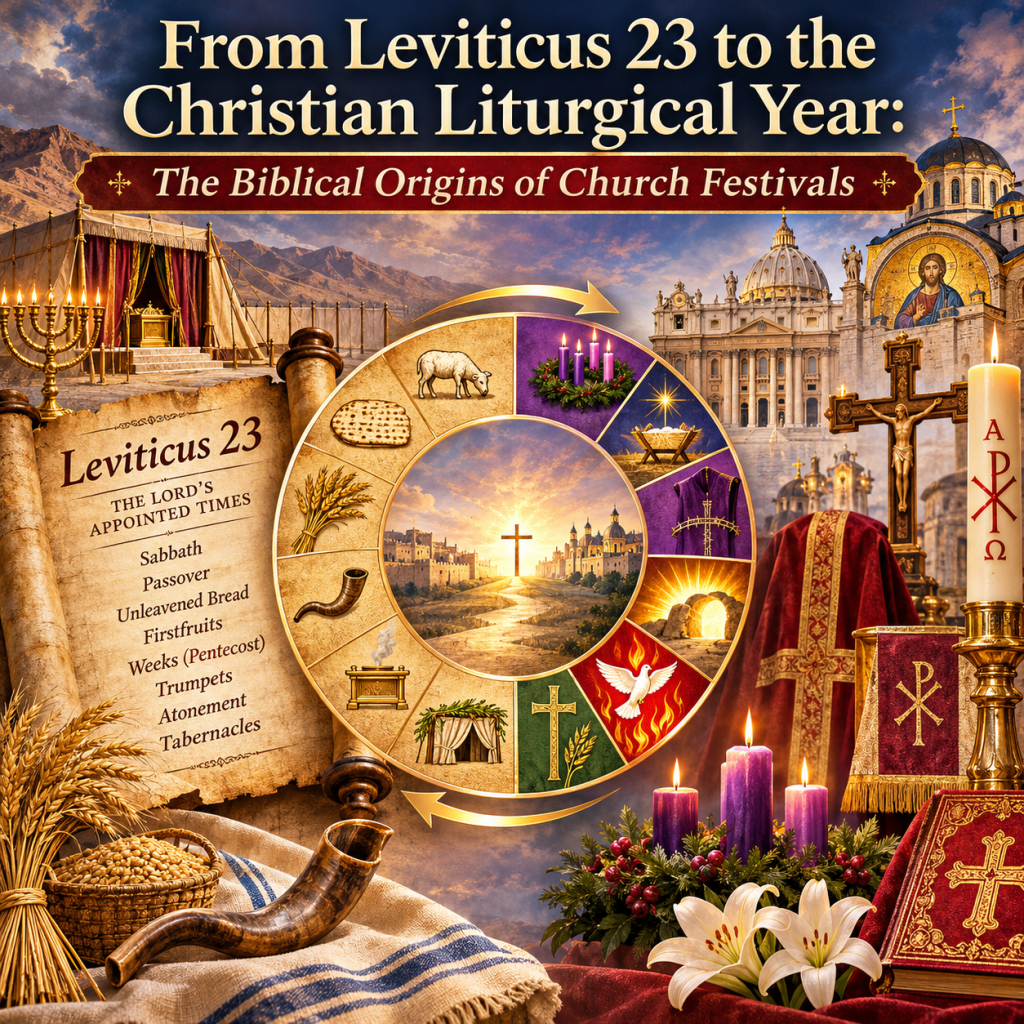
The annual feasts and festivals observed by Roman Catholic and Eastern Orthodox Christians bear notable similarities to the appointed times prescribed for Israel in Leviticus 23. Both traditions organize worship around recurring occasions of remembrance, preparation, thanksgiving, and celebration. Several central Christian feasts also commemorate events that the New Testament directly associates with Israel’s appointed times.
Download full article as PDF: From Leviticus 23 to the Christian Liturgical Year
These similarities raise an important historical question: How did the appointed times of Israel relate to the development of the Christian liturgical calendar?
Leviticus 23 identifies the weekly Sabbath, Passover, Unleavened Bread, First Fruits, Weeks, Trumpets, the Day of Atonement, and Booths as appointed times given to Israel through Moses. These observances included holy convocations, prescribed offerings, and ceremonial requirements associated with particular dates.
Christianity emerged within this Jewish setting. Jesus and His apostles observed the appointed times, and several events central to the Christian faith occurred during their celebration. Christ was crucified during the Passover period, rose from the dead during the same festival season, and the Holy Spirit descended upon the disciples at Pentecost.
As Christianity spread, Christians gradually developed an annual calendar commemorating Christ’s incarnation, death, resurrection, ascension, and the descent of the Holy Spirit. Additional observances honoring Mary, the apostles, martyrs, and other saints were incorporated over subsequent centuries.
The resulting calendars preserve important biblical connections while also containing observances established through later church tradition.
Israel’s Appointed Times and the Christian Calendar
God introduced Israel’s appointed times in Leviticus:
“The LORD’s appointed times which you shall proclaim as holy convocations—My appointed times are these.” (Leviticus 23:2 NASB)
These observances were commandments given to Israel. Their dates, sacrifices, and ceremonial requirements were established through the Law of Moses.
The Roman Catholic Church organizes its liturgical year through the General Roman Calendar and the Roman Missal. Its principal seasons include Advent, Christmas, Lent, the Paschal Triduum, Easter, and Ordinary Time.
Eastern Orthodox Christians observe a related but distinct calendar centered upon Pascha, or Easter, together with Great Lent, Pentecost, the Nativity, and the Twelve Great Feasts. Their ecclesiastical year begins on September 1, and their services follow Byzantine liturgical books rather than the Roman Missal.
Although their calendars differ, both traditions commemorate many of the same events in Christ’s life.
The following comparison identifies the principal relationships.
| Leviticus 23 | Roman Catholic Calendar | Eastern Orthodox Calendar |
| Weekly Sabbath | Sunday Mass | Sunday Divine Liturgy |
| Passover | Easter and Paschal Triduum | Holy Week and Pascha |
| Unleavened Bread | Holy Week | Great and Holy Week |
| First Fruits | Easter | Pascha |
| Feast of Weeks | Pentecost | Holy Pentecost |
| Trumpets | No direct equivalent | No direct equivalent |
| Day of Atonement | Good Friday | Great and Holy Friday |
| Feast of Booths | Incarnation and Transfiguration themes | Nativity and Transfiguration themes |
These comparisons represent different kinds of relationships. Some are established explicitly in Scripture, while others are historical associations or theological interpretations.
Passover and the Christian Celebration of Easter
The strongest connection concerns Passover and Easter.
Passover commemorated Israel’s deliverance from Egypt. The blood of the Passover lamb marked the households of the Israelites when judgment came upon Egypt (Exodus 12:1–14).
The apostle Paul expressly identifies Christ with that sacrifice:
“For Christ our Passover also has been sacrificed.” (1 Corinthians 5:7 NASB)
Both Roman Catholic and Orthodox Christians commemorate Christ’s death and resurrection through their Paschal celebrations. The term Pascha itself derives from the Greek word associated with Passover.
This relationship is more substantial than a resemblance between annual festivals. Christ’s death occurred during the Passover period, and the New Testament identifies His sacrifice as the fulfillment of the Passover offering.
The Christian celebration, however, does not reproduce the ceremonial requirements given to Israel. The Passover lamb and its prescribed ceremonies were fulfilled through Christ’s sacrifice.
The annual Christian observance commemorates His completed work rather than repeating the original Passover sacrifice.
Unleavened Bread and First Fruits
The Feast of Unleavened Bread immediately followed Passover. Its seven-day observance recalled Israel’s departure from Egypt and included the removal of leaven.
Paul applies this imagery to Christian conduct, calling believers to reject malice and wickedness and to live in sincerity and truth (1 Corinthians 5:7–8).
Roman Catholic and Orthodox Holy Week observances likewise include preparation, penitence, and remembrance of Christ’s suffering. These practices resemble aspects of Unleavened Bread, although their specific fasting requirements developed through later church discipline.
The connection between First Fruits and Christ’s resurrection is more direct.
Leviticus 23:9–14 instructed Israel to present the first sheaf of the harvest before the Lord. Paul identifies the resurrection of Christ with this offering:
“But now Christ has been raised from the dead, the first fruits of those who are asleep.” (1 Corinthians 15:20 NASB)
Christ’s resurrection establishes the resurrection life received through Him. Just as the first sheaf represented the beginning of the harvest, Christ’s resurrection establishes the resurrection of those who belong to Him.
Both Christian traditions commemorate this event through Easter or Pascha. Neither ordinarily reproduces the original ceremonial offering of the first sheaf.
Pentecost: A Direct Historical Connection
The Feast of Weeks provides another explicit connection.
Israel celebrated this appointed time after counting seven complete weeks, reaching the fiftieth day. Its observance included harvest offerings and a holy convocation (Leviticus 23:15–22).
The New Testament records that the Holy Spirit descended upon the disciples during this Jewish festival:
“When the day of Pentecost had come, they were all together in one place.” (Acts 2:1 NASB)
Roman Catholic and Eastern Orthodox Christians continue to celebrate Pentecost fifty days after Easter or Pascha.
The name, numerical relationship, and historical occasion are retained. The purpose of the Christian observance, however, concerns the descent of the Holy Spirit rather than the grain offerings prescribed in Leviticus.
Pentecost therefore demonstrates how a Christian festival could develop directly from an event occurring during one of Israel’s appointed times.
Trumpets and the Day of Atonement
The Feast of Trumpets, observed on the first day of the seventh month, was a day of rest and remembrance accompanied by trumpet blasts (Leviticus 23:23–25).
Neither Roman Catholic nor Eastern Orthodox Christianity has a universal annual festival directly reproducing this observance.
Although Christian Advent readings address judgment, watchfulness, and Christ’s coming, Scripture does not identify Advent as the fulfillment of the Feast of Trumpets. Their similarities are thematic rather than evidence of direct historical succession.
The Day of Atonement presents a different relationship.
Leviticus 16 prescribed annual ceremonies through which the high priest made atonement for Israel. Hebrews 9–10 expressly relates these ceremonies to Christ’s sacrifice and heavenly priesthood.
Unlike the former priests, who repeatedly offered sacrifices, Christ offered one sacrifice for sins (Hebrews 10:11–12).
Roman Catholic Good Friday and Orthodox Great and Holy Friday commemorate Christ’s suffering and death. They consequently resemble the Day of Atonement in their attention to sin, repentance, and Christ’s sacrifice.
Nevertheless, the biblical fulfillment belongs to Christ’s priestly work, not to the establishment of another annual atonement ceremony.
The Feast of Booths and God’s Dwelling Among Humanity
The Feast of Booths commemorated Israel’s dwelling in temporary shelters following the departure from Egypt (Leviticus 23:33–44).
The New Testament employs related language when describing the incarnation:
“And the Word became flesh, and dwelt among us, and we saw His glory.” (John 1:14 NASB)
The Greek verb translated dwelt is related to the language of pitching a tent or tabernacling.
This provides a meaningful theological connection between God’s presence among Israel and His dwelling among humanity through Christ.
Both Roman Catholic and Orthodox Christians commemorate the incarnation through the Nativity. Orthodox interpretation also associates the Feast of Booths with the Transfiguration, particularly Peter’s proposal to construct three tabernacles (Matthew 17:4).
These connections do not establish that Christmas or the Transfiguration feast was commanded in Leviticus. They are interpretations relating events in Christ’s ministry to biblical imagery concerning God’s dwelling among His people.
Advent, Lent, and Later Church Festivals
Not every Christian observance corresponds to an appointed time in Leviticus 23.
Roman Catholic Advent precedes Christmas, while Lent prepares for Easter. Eastern Orthodox Christians observe the Nativity Fast and Great Lent before their corresponding celebrations.
These seasons reflect the church’s historical development of recurring practices of fasting, preparation, and commemoration.
The calendars also include feasts honoring Mary, the apostles, martyrs, and other saints. Some commemorate biblical events, while others depend principally upon later ecclesiastical tradition.
A distinction must therefore be maintained between an event recorded in Scripture and an annual celebration subsequently established by the church.
The fact that Scripture records an event does not automatically establish a divine commandment requiring its annual commemoration.
The Sabbath and Sunday Worship
Leviticus 23 begins with the weekly Sabbath, which must be distinguished from the annual ceremonial festivals.
The Fourth Commandment requires rest from labor, including provision for servants and animals (Exodus 20:8–11).
Roman Catholic and Orthodox Christians ordinarily conduct their principal weekly Eucharistic celebrations on Sunday in remembrance of Christ’s resurrection.
The New Testament records Christians assembling on the first day of the week (Acts 20:7). However, this practice does not itself establish that the seventh-day requirement concerning rest was ceremonially transferred to Sunday.
The Sabbath’s moral obligation concerning rest must therefore be distinguished from the ceremonial requirements of Israel’s annual appointed times and from the church’s later practices of weekly worship.
Biblical Fulfillment and Ecclesiastical Tradition
The essential difference between the calendars concerns the authority by which their observances were established.
Leviticus 23 contains commandments given by God to Israel through Moses. The Roman Catholic and Eastern Orthodox calendars developed through the church’s historical organization of worship.
The New Testament identifies several appointed times with Christ’s completed messianic work. Passover is fulfilled in His sacrifice, First Fruits in His resurrection, and the priestly ceremonies of the Day of Atonement in His atoning work and heavenly priesthood. Pentecost became the occasion upon which the Holy Spirit descended upon the disciples.
Other festivals commemorate biblical events without corresponding directly to ceremonial requirements in Leviticus. Still others developed through later ecclesiastical tradition.
The historical existence of a Christian festival does not establish its divine institution, just as a resemblance to an appointed time does not prove that the church intended to continue its ceremonial requirements.
Each observance must be examined according to its biblical basis, historical origin, and theological purpose.
Conclusion
The Roman Catholic and Eastern Orthodox liturgical calendars retain significant connections with Israel’s appointed times, especially through Passover, First Fruits, and Pentecost.
Other comparisons, including Trumpets, the Day of Atonement, and Booths, require distinctions between explicit biblical fulfillment, theological interpretation, and later church commemoration.
Christianity emerged within Israel’s historical setting, and the apostles explained Christ’s ministry in relation to the Law, the Prophets, and the Psalms (Luke 24:44). The church subsequently established annual observances commemorating these events and additional aspects of Christian history.
The decisive distinction is between what Christ fulfilled through His messianic work and what the church later established for annual worship.
Recognizing that difference allows the biblical relationships to be understood without confusing God’s appointed ceremonial requirements with the historical development of Christian liturgical practice.
Further Reading
Download the complete study: From Leviticus 23 to the Christian Liturgical Year
The accompanying PDF provides a more detailed examination of each appointed time, its New Testament relationship, and its corresponding celebrations in Roman Catholic and Eastern Orthodox Christianity. It also includes Scripture references, theological distinctions, and historical sources for further study.
Download PDF: From Leviticus 23 to the Christian Liturgical Year