Did the New Testament Borrow Greek Mythology?
The New Testament was written in Greek, a language that had been used for centuries before the apostles wrote Scripture. Words such as Hades already had meanings and cultural associations familiar to Greek speakers.
This raises an important question. When the New Testament uses the word Hades, is it adopting Greek mythology, or is it using familiar Greek vocabulary to communicate biblical teaching?
The answer becomes much clearer when we compare the Hebrew Old Testament, the Greek Septuagint, and the New Testament.
Sheol Became Hades in the Greek Old Testament
The Hebrew Old Testament regularly uses the word Sheol for the realm of death. When Jewish translators translated the Hebrew Scriptures into Greek centuries before Christ, they frequently translated Sheol with the Greek word ᾅδης (Hadēs).
This can be seen directly by comparing the passages. In Genesis 37:35, Jacob believed that Joseph was dead and said:
Modern English:
“All his sons and all his daughters rose up to comfort him, but he refused to be comforted. He said, ‘For I will go down to Sheol to my son mourning.’ His father wept for him.”
—Genesis 37:35 WEB
The Septuagint renders the same thought:
“And all his sons and his daughters gathered themselves together, and came to comfort him; but he would not be comforted, saying, I will go down to my son mourning to Hades; and his father wept for him.”
—Genesis 37:35 LXX, Brenton
The Greek reads:
εἰς ᾅδου
“to Hades”
The Hebrew concept is Sheol. The Greek translators used Hades.
They were not teaching that Jacob expected to meet the pagan god Hades. They were using the ordinary Greek word Hadēs to translate the biblical word Sheol. IN Psalm 16:10, The same relationship appears in an important Messianic Psalm.
Modern English:
“For you will not leave my soul in Sheol, neither will you allow your holy one to see corruption.”
—Psalm 16:10 WEB
The Septuagint says:
“Because thou wilt not leave my soul in Hades, neither wilt thou suffer thine Holy One to see corruption.”
—Psalm 15:10 LXX, Brenton
The Greek phrase is:
οὐκ ἐγκαταλείψεις τὴν ψυχήν μου εἰς ᾅδην
“You will not leave my soul in Hades.”
The Septuagint numbering is Psalm 15:10; in most English Bibles it is Psalm 16:10. The important point is that Sheol is rendered Hades. The New Testament then makes the connection even clearer. Peter quotes this very Psalm concerning Christ:
“because you will not leave my soul in Hades, neither will you allow your Holy One to see decay.”
—Acts 2:27 WEB
Peter uses Hades because he is quoting the Greek Old Testament wording of the Psalm. This gives us a direct biblical chain:
Hebrew Old Testament: Sheol
Greek Septuagint: Hades
New Testament: Hades
The New Testament did not need to borrow a pagan doctrine of Hades. Greek-speaking Jews had already been reading Hades as the Greek biblical term for Sheol for generations. In Isaiah 14:9, The same usage appears in Isaiah:
Modern English:
“Sheol from beneath has moved for you to meet you at your coming. It stirs up the dead for you, even all the chief ones of the earth; it has raised up from their thrones all the kings of the nations.”
—Isaiah 14:9 WEB
The Greek Septuagint begins:
ὁ ᾅδης κάτωθεν
“Hades beneath…”
Again the Hebrew/English Sheol becomes Greek Hades. The biblical evidence is therefore straightforward. Hades had become established Greek biblical vocabulary for the realm called Sheol in Hebrew.
Hades in Luke 16
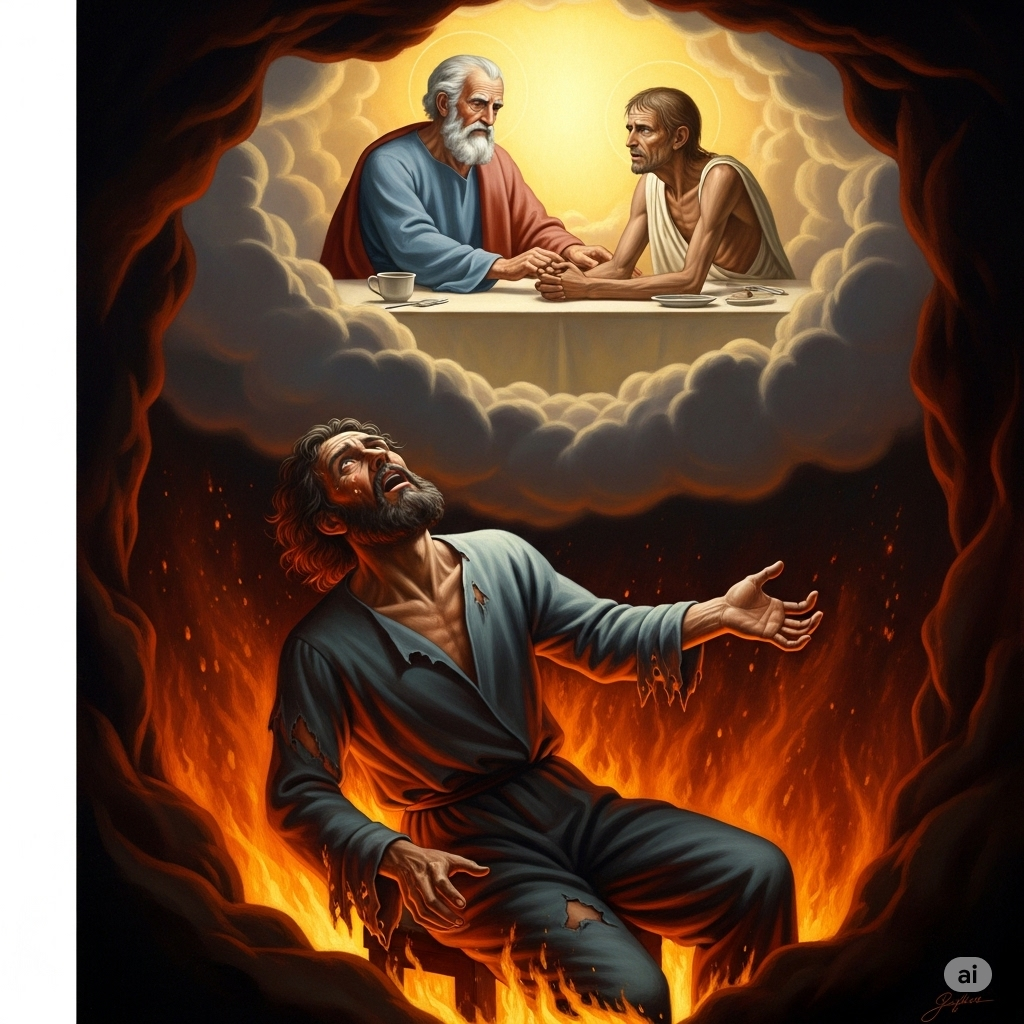
This background is important when Jesus speaks of the rich man and Lazarus:
“And the poor man died, and he was carried away by the angels to Abraham’s bosom: and the rich man also died, and was buried. And in Hades he lifted up his eyes, being in torments, and seeth Abraham afar off, and Lazarus in his bosom.”
—Luke 16:22–23 ASV
A Greek-speaking reader already knew Hades as the word used in the Greek Scriptures for Sheol. The passage then describes the two men differently. Lazarus dies and is carried away by the angels to Abraham, where Abraham receives him into his bosom—his embrace. The rich man dies, is buried, and then “in Hades he lifted up his eyes.”
Luke does not say that Lazarus was carried into another compartment of Hades. Neither does he use “Abraham’s bosom” as the stated name of a geographical region. The text gives the location Hades specifically to the rich man.
The Great Chasm
Abraham later tells the rich man:
“And besides all this, between us and you there is a great gulf fixed, that they that would pass from hence to you may not be able, and that none may cross over from thence to us.”
—Luke 16:26 ASV
The Greek expression is:
χάσμα μέγα (chasma mega)
“a great chasm” or “a great gulf.”
The passage itself tells us what this chasm does: it prevents crossing. Yet the rich man can see Abraham, speak to him, and hear Abraham’s answer. The chasm prevents passage from one condition to the other; it does not prevent sight or communication.
What About the River Styx?
There is a genuine cultural similarity here. Greek mythology described the realm of Hades with rivers including Acheron, Cocytus, Pyriphlegethon, and Styx. Homer, for example, describes these rivers in connection with the “house of Hades” in Odyssey 10.513–515. A Greek reader could therefore recognize familiar imagery when hearing words such as Hades, torment, and an impassable boundary. But Luke never calls the chasm Styx. He calls it:
χάσμα μέγα — a great chasm.
There is therefore no biblical basis for saying that Jesus’ great chasm is the River Styx. A cultural resemblance is not the same thing as a biblical identification.
Familiar Greek Words Do Not Make the Doctrine Greek
Psalm 16 gives us perhaps the clearest proof. The Hebrew Scripture says:
Sheol
The Septuagint translates:
Hades
Peter then quotes that Greek wording:
“because you will not leave my soul in Hades…”
—Acts 2:27 WEB
Peter obviously is not teaching that Christ was abandoned to or rescued from the pagan deity Hades. He is using the established Greek biblical vocabulary inherited from the Septuagint. The vocabulary is Greek. The teaching is biblical. This is no different in principle from an English Bible using the word hell. The history of an English word does not determine the doctrine of the passage. Scripture determines what the word means in its biblical context.
Do Not Read the Entire Greek Underworld Back Into Luke 16
This becomes important when interpreting the doctrine commonly called “Abraham’s Bosom.” A two-compartment interpretation can be constructed by combining several ideas: Hades is treated as the name of the entire scene. Abraham’s embrace of Lazarus becomes a geographical place called “Abraham’s Bosom.” That place is then identified with Paradise, and the great chasm becomes the boundary dividing two regions within one Hades.
Luke does not state those connections. The passage itself is simpler. The rich man dies, is buried, and in Hades lifts up his eyes in torment. Lazarus dies and is carried away by angels to Abraham, who receives him into his embrace. A great fixed chasm prevents anyone from crossing between them.
The text gives us Hades, Abraham, Lazarus, torment, an embrace, and an uncrossable chasm. It does not give us a detailed map of a two-compartment underworld.
The Chasm and the Presence of the Righteous
Luke 16 also presents the rich man and Abraham as mutually aware of one another. The rich man sees Abraham and speaks to him, while Abraham responds. What the chasm prevents is crossing. This agrees with another description of final judgment:
“he also shall drink of the wine of the wrath of God, which is prepared unmixed in the cup of his anger; and he shall be tormented with fire and brimstone in the presence of the holy angels, and in the presence of the Lamb:”
—Revelation 14:10 ASV
The wicked are tormented in the presence of the Lamb and the holy angels. Luke likewise portrays the rich man in torment while remaining aware of Abraham and Lazarus. The separation is real and impassable, but Scripture does not describe it as complete absence from the righteous or from Christ.
Conclusion
The Septuagint provides the simplest explanation for the New Testament use of Hades. The Hebrew Scriptures used Sheol. Greek-speaking Jewish translators rendered Sheol as ᾅδης — Hades. The apostles then continued using that established Greek biblical vocabulary. Psalm 16 demonstrates the relationship directly:
Psalm 16:10 — Sheol
Septuagint Psalm 15:10 — Hades
Acts 2:27 — Hades
The use of the word Hades therefore does not mean that Christianity adopted the Greek god Hades or the mythological geography associated with him.
Greek mythology did contain familiar descriptions of Hades, Styx, and boundaries of the dead, so Greek readers could recognize cultural similarities. But Luke never identifies his great chasm with Styx, nor does he provide a Greek mythological map of the afterlife. Scripture should interpret the vocabulary. The Greek word was familiar. The revelation was biblical.