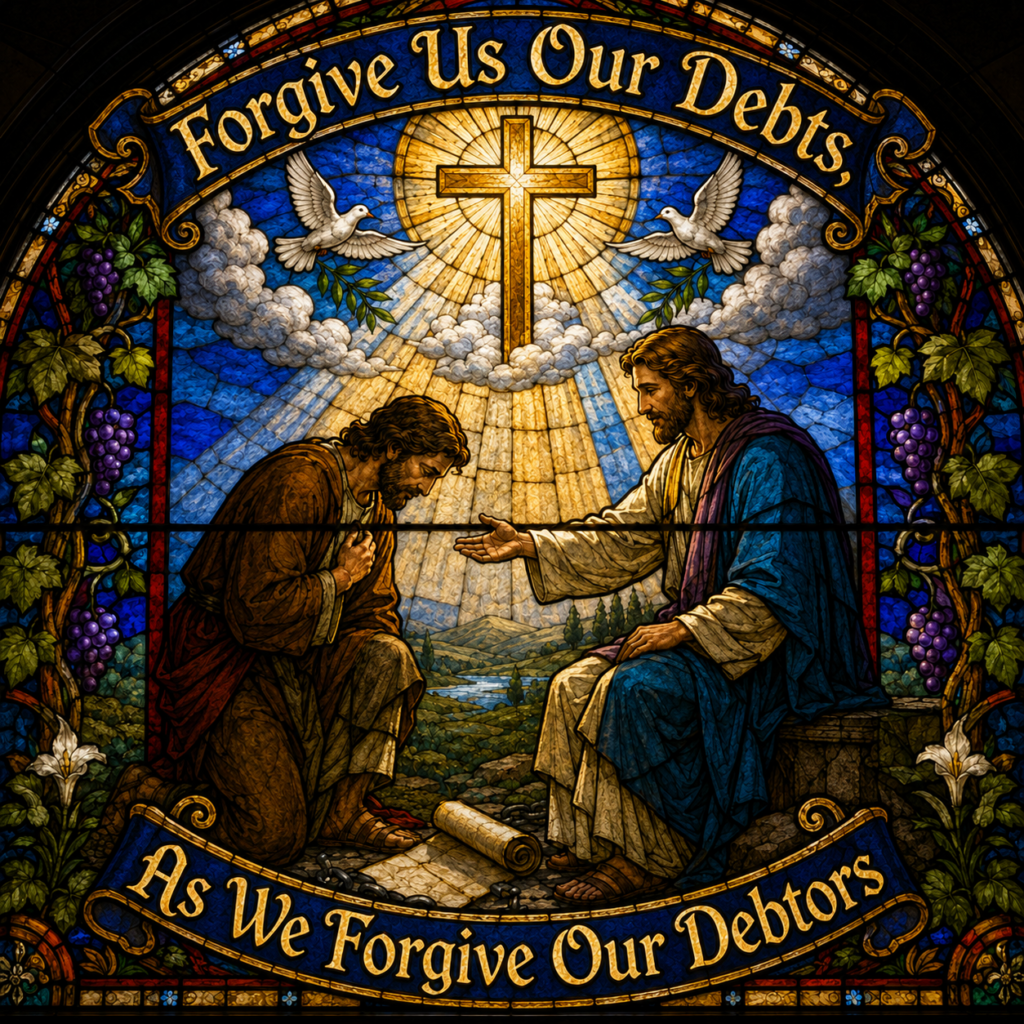
Jesus teaches His disciples to pray:
“And forgive us our debts, as we also have forgiven our debtors.” (Matthew 6:12 NASB)
This petition concerns both our dependence upon God’s forgiveness and our responsibility toward those who have sinned against us. There are debts we owe, and there are debts owed to us. Luke records the same petition this way:
“And forgive us our sins, For we ourselves also forgive everyone who is indebted to us.” (Luke 11:4 NASB)
Luke identifies the debts as sins and the debtors as people who are indebted “to us.” The emphasis is therefore upon sins committed between one person and another. Jesus summarized the law:
“YOU SHALL LOVE THE LORD YOUR GOD WITH ALL YOUR HEART, AND WITH ALL YOUR SOUL, AND WITH ALL YOUR MIND.” “YOU SHALL LOVE YOUR NEIGHBOR AS YOURSELF.” (Matthew 22:37, 39 NASB)
Paul applies the commandments concerning adultery, murder, theft, and coveting directly to love of neighbor:
“If there is any other commandment, it is summed up in this saying, ‘YOU SHALL LOVE YOUR NEIGHBOR AS YOURSELF.’” (Romans 13:9 NASB)
When someone wrongs us, a real moral debt exists. Christ does not deny the offense. He teaches us how a person who has received forgiveness must treat the person who owes that debt.
Sin Against Our Neighbor Is Still Sin Before God.
Sins against our neighbor are also sins against God because God commanded us to love our neighbor. Joseph said:
“How then could I do this great evil and sin against God?” (Genesis 39:9 NASB)
David likewise prayed:
“Against You, You only, I have sinned And done what is evil in Your sight.” (Psalm 51:4 NASB)
Therefore, when we wrong our neighbor, we violate God’s command. When our neighbor wrongs us, he becomes our debtor. The petition places our response to that debtor before God.
Forgiveness Is Not Obtained Merely by Asking.
Jesus teaches us to say “forgive us our debts.” Scripture does not teach that God forgives our sins simply by asking.
“Without shedding of blood there is no forgiveness.” (Hebrews 9:22 NASB)
“In Him we have redemption through His blood, the forgiveness of our trespasses.” (Ephesians 1:7 NASB)
“He Himself bore our sins in His body on the cross.” (1 Peter 2:24 NASB)
Prayer is not a means of forgiveness of sins. Christ’s blood is the ground of forgiveness. We are not forgiven because we ask correctly, feel sufficiently sorry, perform religious works, or first forgive another person. We are forgiven because Christ bore the penalty of sin. John places confession and Christ’s blood together:
“The blood of Jesus His Son cleanses us from all sin.” (1 John 1:7 NASB)
“If we confess our sins, He is faithful and righteous to forgive us our sins.” (1 John 1:9 NASB)
Confessing sin is acknowledging our guilt publicly before others. We are not to act like we are sinless righteous people.
“Beware of practicing your righteousness before men to be noticed by them; otherwise you have no reward with your Father who is in heaven.” (Matt 6:1 NAS)
Our confession is public in confessing Christ as our savior.
“If you confess with your mouth Jesus as Lord, and believe in your heart that God raised Him from the dead, you shall be saved; for with the heart man believes, resulting in righteousness, and with the mouth he confesses, resulting in salvation.” (Rom 10:9-10 NAS)
“Everyone therefore who shall confess Me before men, I will also confess him before My Father who is in heaven. “But whoever shall deny Me before men, I will also deny him before My Father who is in heaven.” (Matt 10:32-33 NAS)
There are no sacrifices or prayers we can offer that will obtain forgiveness from God. Only Christ’s sacrifice.
“For if we go on sinning willfully after receiving the knowledge of the truth, there no longer remains a sacrifice for sins, but a certain terrifying expectation of judgment, and the fury of a fire which will consume the adversaries.” (Heb 10:26-27 NAS)
God requires repentance and faith, not empty religious acts, repeated prayers, or outward gestures without a believing heart.
“I did not shrink from declaring to you anything that was profitable, and teaching you publicly and from house to house, solemnly testifying to both Jews and Greeks of repentance toward God and faith in our Lord Jesus Christ.” (Acts 20:20-21 NAS)
If forgiveness came merely by asking God each time we sinned, then Christ would not have needed to die as the atoning sacrifice for sin. This is similar to the Islamic objection that God can simply forgive the sinner who asks, without the need for Christ’s substitutionary death. Prayer does not atone for sin; Christ does. Moreover, we cannot even identify and confess every sin we commit, because some sins are committed unknowingly. Therefore, our forgiveness cannot rest on the completeness of our prayers or confessions, but entirely on the finished work of Christ.
Forgiveness Must Come From the Heart.
When Jesus teaches us to pray, “forgive us our debts, as we also have forgiven our debtors,” He is not teaching us that we can simply ask God for forgiveness while refusing to forgive other people. Immediately after the Lord’s Prayer, He explains what He means:
“For if you forgive others for their transgressions, your heavenly Father will also forgive you. But if you do not forgive others, then your Father will not forgive your transgressions.” (Matthew 6:14–15 NASB)
So the words of the prayer cannot be separated from the condition Jesus places on the heart.
This does not mean that we earn forgiveness by forgiving other people. Scripture is clear that forgiveness comes only through the atoning work of Christ.
“Without shedding of blood there is no forgiveness.” (Hebrews 9:22)
“In Him we have redemption through His blood, the forgiveness of our trespasses.” (Ephesians 1:7)
So our forgiveness of others is not the payment for our own sins. Christ is the payment. But Jesus also makes clear that a person cannot ask for mercy from God while deliberately refusing mercy to someone else.
He makes this even clearer in the parable of the unforgiving servant. The servant had been forgiven an enormous debt. Yet afterward, he refused to forgive a much smaller debt owed to him. His master said:
“I forgave you all that debt because you pleaded with me. Should you not also have had mercy on your fellow slave, in the same way that I had mercy on you?” (Matthew 18:32–33 NASB)
Then the master judged him. Jesus concludes the parable by saying:
“So shall My heavenly Father also do to you, if each of you does not forgive his brother from your heart.” (Matthew 18:35 NASB)
Those last words are crucial: “From your heart.” Forgiveness is not merely saying the words, “I forgive you.” It is not an empty gesture. It is not pretending that the wrong never happened. It is a real disposition of the heart in which we surrender personal vengeance and refuse to hold the debt over another person as a justification for hatred or retaliation.
We cannot say, “Lord, forgive my debts,” while at the same time saying, “But I will never forgive the person who is indebted to me.” The person who has truly received forgiveness must become forgiving. Paul says:
“Just as the Lord forgave you, so also should you.” (Colossians 3:13 NASB)
So forgiveness from the heart is not the cause of salvation. Christ is the cause. But a forgiving heart is the necessary fruit of having received His mercy. If a person persistently refuses to forgive, that refusal contradicts the very forgiveness he claims to have received.
Forgiveness Does Not Call Evil Good.
Biblical forgiveness does not mean pretending that evil was harmless. Jesus says:
“If your brother sins, rebuke him; and if he repents, forgive him.” (Luke 17:3 NASB)
The sin may be named and confronted. Yet the Christian must not repay evil with evil. Paul says:
“Never pay back evil for evil to anyone.” (Romans 12:17 NASB)
Therefore: Another person’s sin against me never gives me permission to sin against that person. The offense may be real and serious, but it does not justify personal vengeance.
“Never take your own revenge, beloved, but leave room for the wrath of God.” (Romans 12:19 NASB)
“For rulers are not a cause of fear for good behavior, but for evil. Do you want to have no fear of authority? Do what is good, and you will have praise from the same; For it is a minister of God to you for good. But if you do what is evil, be afraid; for it does not bear the sword for nothing; for it is a minister of God, an avenger who brings wrath upon the one who practices evil.” (Rom 13:3-4 NAS)
Therefore, personal vengeance and lawful justice are not the same. A criminal may repent and be forgiven before God while still serving a lawful sentence. David was forgiven, yet earthly consequences remained:
“The LORD also has taken away your sin; you shall not die.” (2 Samuel 12:13 NASB)
Forgiveness does not erase every temporal consequence.
There is Forgiveness and there is Mercy.
Forgiveness and mercy are closely related, but they are not identical. The Good Samaritan showed mercy to a man who had not sinned against him:
“The one who showed mercy toward him.” (Luke 10:37 NASB)
Mercy relieves suffering. Forgiveness concerns a moral debt. Likewise, forgiveness is not identical to trust or reconciliation. Jesus did not entrust Himself indiscriminately to everyone:
“Jesus, on His part, was not entrusting Himself to them.” (John 2:24 NASB)
“If possible, so far as it depends on you, be at peace with all men.” (Romans 12:18 NASB)
Forgiveness does not require unsafe contact, immediate restoration of trust, or removal of lawful consequences. It requires the surrender of personal vengeance. Paul gives a practical example:
“BUT IF YOUR ENEMY IS HUNGRY, FEED HIM, AND IF HE IS THIRSTY, GIVE HIM A DRINK.” (Romans 12:20 NASB)
Scripture still calls the person “your enemy.” The wrong is not denied. Yet the Christian refuses to use the offense as permission for cruelty. Jesus says:
“Love your enemies and pray for those who persecute you.” (Matthew 5:44 NASB)
Therefore, forgiveness does not mean the offense was small. It means that the offender’s evil will not determine our own conduct. Paul concludes:
“Do not be overcome by evil, but overcome evil with good.” (Romans 12:21 NASB)
If we repay evil with evil, evil has multiplied. If we refuse vengeance and continue to do good, evil does not govern us.
Justice Belongs to God.
The Christian can surrender personal vengeance because God remains the Judge.
“VENGEANCE IS MINE, I WILL REPAY,” says the Lord. (Romans 12:19 NASB)
“Shall not the Judge of all the earth deal justly?” (Genesis 18:25 NASB)
Christ Himself suffered unjustly, yet:
“While being reviled, He did not revile in return; while suffering, He uttered no threats, but kept entrusting Himself to Him who judges righteously.” (1 Peter 2:23 NASB)
So when Jesus teaches us to pray: “Forgive us our debts, as we also have forgiven our debtors,” the petition acknowledges two realities. We ourselves are debtors who depend entirely upon the forgiveness purchased by Christ. And because we have been forgiven, we are obligated to forgive those who become indebted to us.
“Just as the Lord forgave you, so also should you.” (Colossians 3:13 NASB)
Another person’s sin against us never gives us permission to sin against that person. Therefore, every time we pray, “Forgive us our debts, as we also have forgiven our debtors,” we confess:
I live by the forgiveness purchased for me through the blood of Christ. Therefore, I will not use another person’s debt as justification for my own sin, but will leave vengeance to God and overcome evil with good.